AutoGen vs CrewAI: Choosing the Right Framework

AutoGen vs CrewAI: head-to-head on architecture, ease of use, and use cases for multi-agent systems. Pick the right framework.
AutoGen vs CrewAI: Choosing the Right Multi-Agent Framework
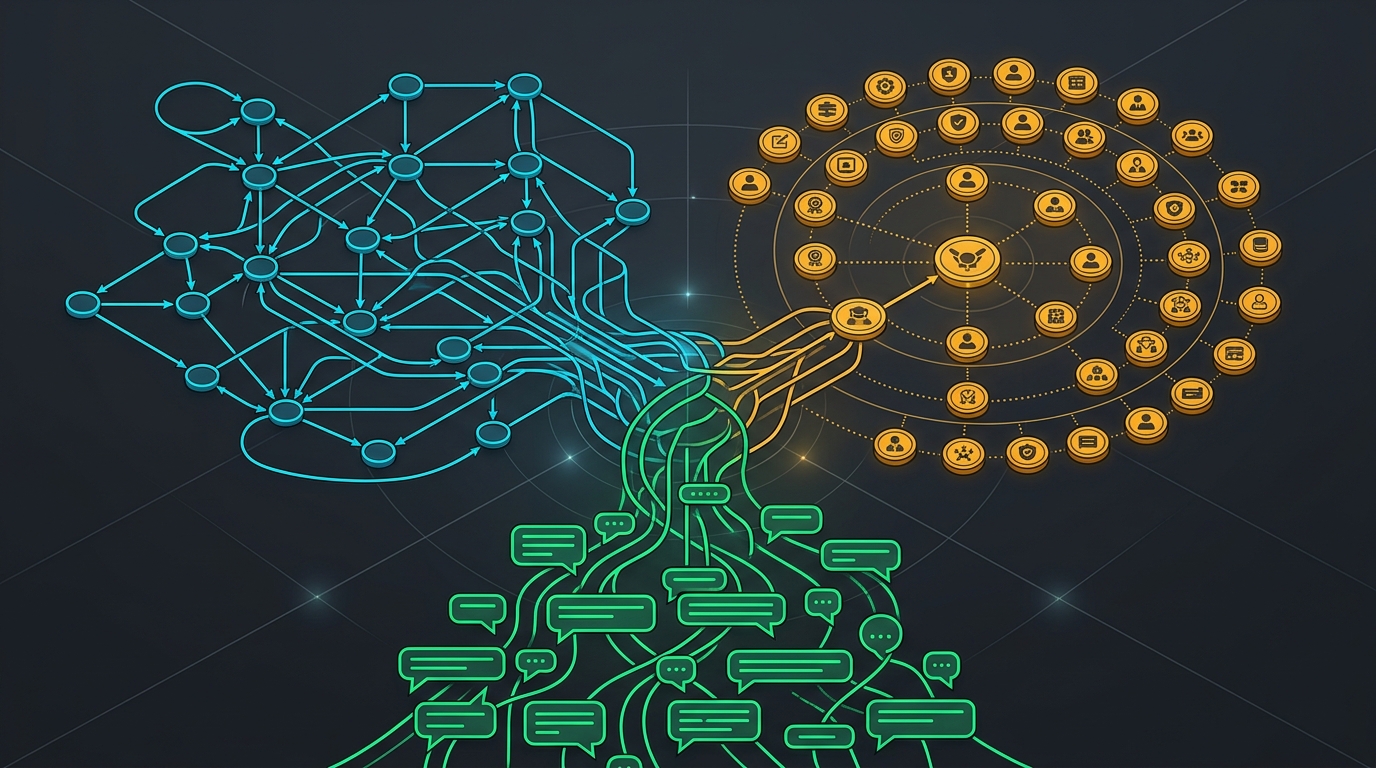
Building AI systems that involve multiple agents working together has become one of the most exciting frontiers in applied AI. Two frameworks have emerged as leading options for developers: Microsoft’s AutoGen and CrewAI. Both enable multi-agent collaboration, but they take fundamentally different approaches. This guide breaks down their architectures, features, and ideal use cases to help you choose the right tool for your project.
Overview of Each Framework

AutoGen
AutoGen is an open-source framework developed by Microsoft Research. Originally designed for research into multi-agent conversation patterns, it has evolved into a production-capable framework for building complex agent systems. AutoGen 0.4, released in late 2024, represents a significant architectural overhaul that makes it more modular and extensible.
Core philosophy: AutoGen treats agents as conversational entities. Agents communicate by exchanging messages, and complex behaviors emerge from these conversations. This design is heavily influenced by research into emergent intelligence and collaborative problem-solving.
CrewAI
CrewAI is an open-source framework that takes a more structured approach to multi-agent systems. Created by João Moura, it models agent collaboration after real-world team dynamics, with agents assigned specific roles, goals, and tasks within a defined process flow.
Core philosophy: CrewAI thinks of agents as team members with distinct responsibilities. You define who does what, how they collaborate, and what success looks like. This makes it intuitive for developers coming from traditional software engineering backgrounds.
Architecture Comparison
AutoGen’s Conversation-Centric Model
AutoGen’s architecture revolves around agent-to-agent messaging. The key abstractions are:
- Agents: Entities that can send and receive messages
- Teams: Groups of agents that work together
- Termination conditions: Rules that determine when a conversation is complete
- Handoffs: Mechanisms for agents to delegate to other agents
Here’s a simplified example of setting up agents in AutoGen:
from autogen_agentchat.agents import AssistantAgent
from autogen_agentchat.teams import RoundRobinGroupChat
from autogen_ext.models.openai import OpenAIChatCompletionClient

# Create a model client
model = OpenAIChatCompletionClient(model="gpt-4o")

# Create specialized agents
researcher = AssistantAgent(
    "researcher",
    model_client=model,
    system_message="You research topics and gather information."
)

writer = AssistantAgent(
    "writer",
    model_client=model,
    system_message="You write content based on research provided."
)

# Create a team with round-robin conversation
team = RoundRobinGroupChat([researcher, writer], max_turns=4)
AutoGen’s strength is flexibility. You can create custom conversation patterns, implement sophisticated handoff logic, and build agents that dynamically adapt their behavior based on conversation context.
CrewAI’s Role-Based Model
CrewAI structures collaboration around roles, tasks, and processes. The key abstractions are:
- Agents: Entities with defined roles, goals, and backstories
- Tasks: Specific pieces of work with expected outputs
- Crews: Teams of agents organized to complete tasks
- Processes: Execution strategies (sequential, hierarchical)
Here’s the equivalent setup in CrewAI:
from crewai import Agent, Task, Crew, Process

# Create specialized agents
researcher = Agent(
    role="Research Analyst",
    goal="Find comprehensive information on the given topic",
    backstory="You are an expert researcher with a talent for finding relevant information quickly.",
    verbose=True
)

writer = Agent(
    role="Content Writer",
    goal="Create engaging content based on research",
    backstory="You are a skilled writer who transforms research into readable content.",
    verbose=True
)

# Define tasks
research_task = Task(
    description="Research the topic: {topic}",
    expected_output="A comprehensive research summary",
    agent=researcher
)

writing_task = Task(
    description="Write an article based on the research",
    expected_output="A polished article ready for publication",
    agent=writer
)

# Create the crew
crew = Crew(
    agents=[researcher, writer],
    tasks=[research_task, writing_task],
    process=Process.sequential
)
CrewAI’s approach feels more declarative. You define what needs to happen, and the framework handles orchestration.
Feature Comparison
| Feature | AutoGen | CrewAI |
|---|---|---|
| Learning curve | Steeper, more concepts to master | Gentler, intuitive role/task model |
| Flexibility | Very high, supports custom patterns | Moderate, follows defined structures |
| Built-in tools | Requires manual integration | Includes common tools out of the box |
| Memory support | Available via extensions | Built-in short and long-term memory |
| Human-in-the-loop | First-class support | Supported via input tasks |
| Async support | Native async throughout | Synchronous by default |
| Enterprise features | Focused on core functionality | Includes crew training, testing tools |
| Documentation | Comprehensive but technical | Practical, example-driven |
Tool Integration
Both frameworks support tool usage, but the implementation differs significantly.
AutoGen requires you to define tools as functions and register them with agents:
from autogen_core import FunctionTool

def search_web(query: str) -> str:
    """Search the web for information."""
    # Implementation here
    return results

search_tool = FunctionTool(search_web, description="Search the web")
agent = AssistantAgent("agent", tools=[search_tool], model_client=model)
CrewAI provides a decorator-based approach and includes many common tools:
from crewai_tools import SerperDevTool, WebsiteSearchTool

# Use built-in tools
search_tool = SerperDevTool()
web_tool = WebsiteSearchTool()

agent = Agent(
    role="Researcher",
    tools=[search_tool, web_tool],
    # ... other config
)
CrewAI’s approach is more batteries-included, while AutoGen gives you more control over implementation details.
Memory and State
CrewAI has memory built into its core design:
- Short-term memory: Retains context within a crew execution
- Long-term memory: Persists learnings across executions
- Entity memory: Tracks information about specific entities
- Contextual memory: Combines all memory types for rich context
AutoGen handles state through its messaging system and optional checkpointing. Memory implementations are available as extensions but require more setup.
Performance Considerations
Token Usage
Both frameworks consume tokens for agent communication. AutoGen’s conversation-heavy approach can lead to higher token usage when agents engage in extended back-and-forth discussions. CrewAI’s task-oriented design often results in more focused interactions and potentially lower token consumption for equivalent tasks.
Execution Speed
AutoGen’s native async support gives it an edge for applications that need to handle multiple concurrent agent interactions. CrewAI is primarily synchronous, though this is sufficient for many use cases.
Scalability
AutoGen’s distributed architecture (particularly with AutoGen Studio) is designed for enterprise scale. CrewAI is well-suited for team-sized agent groups but may require additional infrastructure for very large deployments.
When to Choose AutoGen
AutoGen is the better choice when you need:
- Complex conversation patterns: Agents that negotiate, debate, or engage in sophisticated dialogue
- Research and experimentation: Exploring new multi-agent architectures
- High customization: Building unique agent behaviors not covered by standard patterns
- Async workloads: Applications handling many concurrent agent sessions
- Microsoft ecosystem integration: Leveraging other Microsoft AI tools and services
Example use cases: Code review systems with back-and-forth discussion, research agents that iteratively refine hypotheses, customer support escalation with nuanced handoffs.
When to Choose CrewAI
CrewAI is the better choice when you need:
- Rapid development: Getting a working multi-agent system quickly
- Structured workflows: Tasks with clear inputs, outputs, and sequences
- Team collaboration metaphors: Systems that mirror human team dynamics
- Built-in tooling: Access to common tools without building integrations
- Production guardrails: Crew training, testing, and deployment features
Example use cases: Content creation pipelines, research report generation, automated data analysis workflows, customer onboarding automation.
Hybrid Approaches
These frameworks aren’t mutually exclusive. Some teams use CrewAI for well-defined workflow automation while using AutoGen for research and complex conversational applications. Both can integrate with LangChain components, making it possible to share tools and model configurations.
Making Your Decision
Here’s a quick decision framework:
-
How well-defined is your workflow?
- Clearly defined steps → CrewAI
- Emergent/dynamic behavior → AutoGen
-
What’s your timeline?
- Need something working this week → CrewAI
- Have time to learn and customize → AutoGen
-
What’s your team’s background?
- Traditional software engineering → CrewAI
- Research/academic background → AutoGen
-
What are your scale requirements?
- Team-sized agent groups → Either works
- Enterprise scale with async → AutoGen
Both frameworks are actively developed with growing communities. AutoGen benefits from Microsoft’s resources, while CrewAI has strong startup momentum and practical focus. Either choice positions you well for building the next generation of AI applications.
Getting Started
AutoGen: Start with the official documentation and the AgentChat tutorial. The team patterns in AutoGen 0.4 are a good entry point.
CrewAI: Begin with the quickstart guide and the example crews. The role-based model becomes intuitive quickly.
Whichever you choose, multi-agent systems represent a powerful paradigm for building AI applications that can handle complex, multi-step tasks. The frameworks are tools—your understanding of the problem domain and thoughtful system design will ultimately determine success.
Looking for more? See our comprehensive Complete Guide to AI Agent Frameworks, or dive deeper with our AutoGen Deep Dive and CrewAI Deep Dive.
Related Posts
LangGraph vs CrewAI vs AutoGen: 2026 Comparison
Graph orchestration vs role-based teams vs Microsoft's new Agent Framework 1.0. Architecture, production readiness, and a clear verdict.

Complete Guide to AI Agent Frameworks 2026
OpenAI Agents SDK, Claude Agent SDK, LangGraph, CrewAI compared — with benchmarks and a decision framework for your AI stack.

The Complete Guide to AI Agent Frameworks in 2024
A comprehensive 3000+ word guide covering all major AI agent frameworks, their architectures, strengths, use cases, and how to choose the right one for your project