Enterprise AI Agent Adoption in 2026: Trends & Barriers

51% of enterprises run AI agents in production. 88% of projects never get there. The 2026 ROI numbers and what separates deployments that scale.
Two years ago, the question was “should we pilot AI agents?” Today, the question is “why aren’t ours in production yet?” The shift is real — but so is the gap between deployment ambitions and execution reality. Here’s what the 2026 data actually shows — and for the latest platform updates shaping this space, see our May 2026 AI agent platform updates.
Where the Numbers Stand
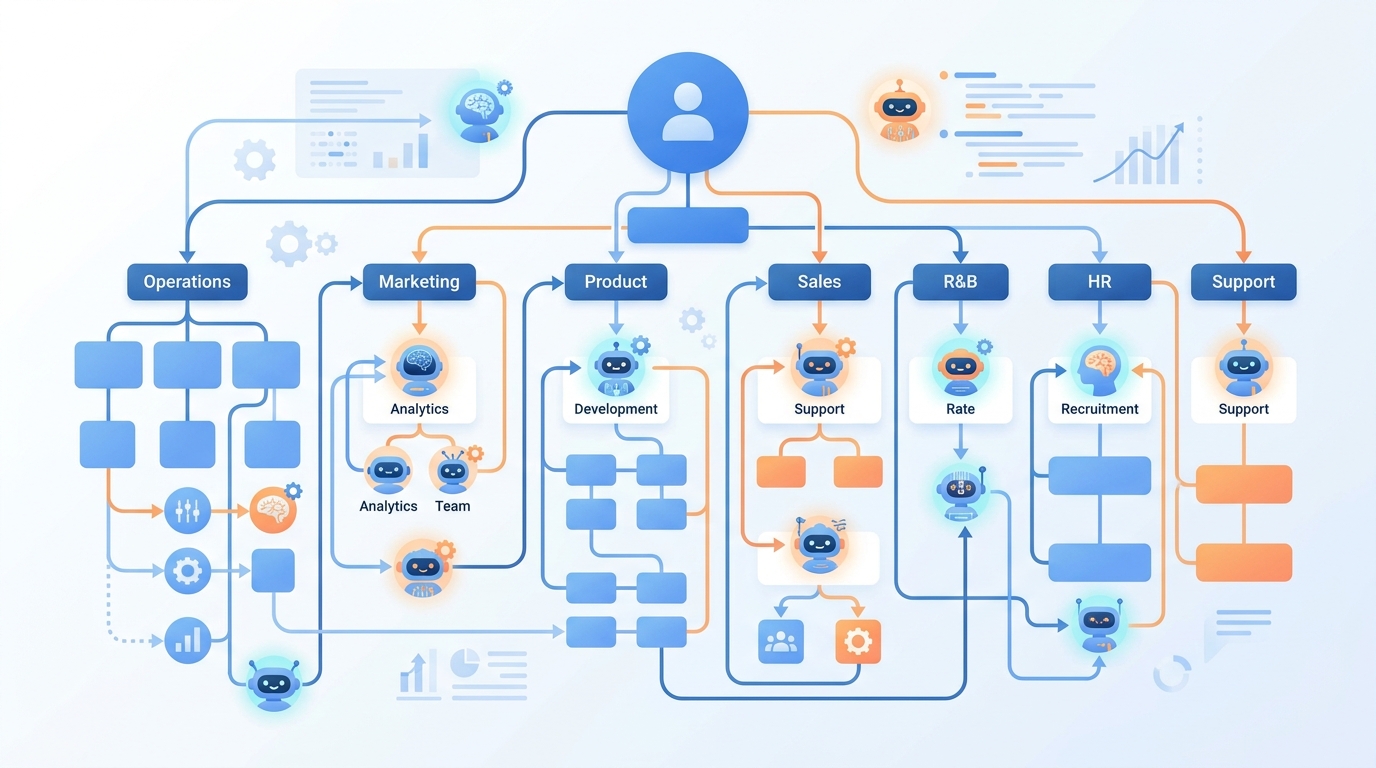
Enterprise AI agent adoption has hit an inflection point in 2026, though the headline numbers require careful reading.
Gartner predicts that 40% of enterprise applications will feature task-specific AI agents by end of 2026, up from less than 5% in 2025. That’s not a modest uptick — it’s an architectural shift in how enterprise software is being built and bought.
McKinsey’s State of AI 2025 report tells a complementary but more nuanced story: 23% of organizations are actively scaling an agentic AI system in at least one business function, and another 39% are experimenting. The headline is that adoption is widespread. The footnote is that “experimenting” and “scaling” are doing a lot of work in that sentence — less than 10% have successfully scaled in any individual function.
The market is following the adoption curve. The global AI agents market hits $10.91 billion in 2026, up from $7.63B in 2025, with IDC projecting overall AI spending to reach $1.3 trillion by 2029 at a 31.9% CAGR.
The Defining Tension: Wide Adoption, Thin Execution
The statistic that should give every engineering lead pause: 88% of AI agents fail to reach production. The organizations in the remaining 12% are generating average ROI of 171% (192% in the US) — see our enterprise AI agent ROI analysis for the full breakdown — exceeding traditional automation by roughly 3x. Of those running agents in production, 74% achieve ROI within the first year, according to Google Cloud’s research.
So we have a market where almost 80% of enterprises have adopted agents in some form, only about half are running them in production, and the gap between those two numbers represents the largest deployment backlog in recent enterprise technology history.
Who’s Leading and What They’re Doing
Finance: JPMorgan Chase as the Benchmark
JPMorgan Chase is the clearest large-scale data point we have. With a $17.5 billion annual technology budget, 450+ AI use cases in production, and 200,000 employees using its proprietary LLM Suite platform daily, the firm is executing what its Chief Analytics Officer calls a plan to build the world’s first “fully AI-connected enterprise.”
The agentic results are concrete: AI agents have reduced manual processing time in the payments division by 35%, and the firm expects AI to generate $2.5 billion in annual value through efficiency gains and revenue growth. Their approach is deliberately “internal-first” — hardening agent systems on employee-facing workflows before deploying them into customer-facing contexts. That sequencing matters and is replicable.
Retail: Walmart’s Purpose-Built Bet
Walmart’s strategy diverges from the default “plug in a foundation model” approach. CTO Hari Vasudev calls it “purpose-built agentic AI” — models trained on Walmart’s proprietary retail data rather than general-purpose LLMs. Their retail-specific model “Wallaby” is trained on decades of transaction data and powers everything from catalog management to personalized shopping.
The scale demonstration: GenAI improved over 850 million product catalog data points — a task CEO Doug McMillon said would have required 100 times the headcount using manual processes. Their internal assistant My Assistant has expanded to 75,000 employees across 11 countries.
Enterprise Software Platforms: Picking a Side
The enterprise software vendors have moved from positioning to shipping. Key snapshots:
- Salesforce Agentforce now has 8,000+ customers. Pricing moved to Flex Credits at $0.10 per action, making cost-per-outcome budgeting practical. Spring ‘26 expanded into regulated financial services with enhanced order routing.
- Microsoft Agent 365 provides a centralized control plane for all agents regardless of origin (Copilot Studio, Azure Foundry, third-party frameworks). Native MCP support is now standard across Copilot Studio and Dynamics 365.
- ServiceNow was ranked #1 for Building and Managing AI Agents in Gartner’s 2025 Critical Capabilities report, with thousands of pre-built agents for ITSM, HR, and customer service.
The battle between these platforms is increasingly about data unification and governance controls, not feature parity on individual agent capabilities.
Industries Where Agents Are Actually Working
The use cases generating real, measurable outcomes in 2026 cluster around a few patterns (for the full sector-by-sector data, see our 2026 industry benchmarks):
Customer service automation remains the highest-volume entry point. Gartner projects autonomous agents will resolve 80% of common customer service issues without human intervention by 2029. Telecom has the highest current adoption rate at 48%, followed by retail/CPG at 47% — both sectors with high-volume, well-defined interaction patterns that reward automation.
Finance and operations — invoice matching, trade settlement, fraud detection — benefit from clear data availability and measurable accuracy metrics. JPMorgan’s 450+ production use cases are heavily weighted here.
IT service management is the most mature vertical. Password resets, software provisioning, incident triage — IT departments consistently report 40-60% ticket volume reduction for routine requests. ServiceNow’s dominance here reflects how well agents perform when the task space is bounded and the integration surface is controlled.
Healthcare is moving more cautiously but at scale. Accenture estimates AI applications could generate $150 billion in annual savings for the industry by 2026, primarily through clinical documentation, prior authorization processing, and patient scheduling.
For a vertical breakdown of healthcare specifically, see our earlier AI Agents in Healthcare analysis.
The Real Barriers in 2026
The barriers have shifted from “can this technology work?” to “can we deploy it responsibly at scale?”
Governance Gaps Are the #1 Production Blocker
A 2026 Gravitee survey found only 24.4% of organizations have full visibility into which AI agents are communicating with each other, and more than half of all agents run without any security oversight or logging. More damning: only 21% of companies have a mature governance model for agents (Deloitte, 2026).
The organizations that piloted in 2025 without audit trail infrastructure are now rebuilding their entire permission and logging architecture before they can pass enterprise security review. That’s an expensive discovery to make post-pilot.
Security Incidents Are Real and Costly
73% of leaders cite security AND data privacy as top concerns (Deloitte’s survey of 3,235 business and IT leaders). This is no longer theoretical risk:
- 63% of organizations cannot enforce purpose limitations on what their agents are authorized to do
- 60% cannot terminate a misbehaving agent once it starts operating
- EY found 64% of companies with annual turnover above $1 billion have lost more than $1 million to AI failures
- Shadow AI (agents deployed outside IT oversight) costs an average $670,000 more per breach than standard security incidents
The specific architecture problem: most organizations treat agents as extensions of human users or generic service accounts rather than independent identity-bearing entities. Only 21.9% of teams grant agents their own identity and apply role-based access control accordingly.
Integration Complexity Hasn’t Gone Away
46% of organizations cite integration with existing systems as their primary deployment challenge (State of AI Agents Report, 2026). The Model Context Protocol (MCP) is gaining traction as a standardization layer — Microsoft has embedded it natively across its agent ecosystem, and it’s now supported by most major frameworks. But MCP adoption doesn’t solve the problem of 20-year-old enterprise systems with no API surface.
The Governance-Speed Tradeoff
The enterprises moving fastest in H1 2026 are the ones that built governance infrastructure before scaling agent autonomy, not after. That requires upfront investment that slows initial deployment but dramatically reduces the probability of the costly rebuild. The 12% hitting production are characterized by four attributes: pre-deployment infrastructure investment, governance documentation before deployment, baseline metrics captured before pilots, and dedicated business ownership with accountability for post-deployment performance.
What Production-Grade Looks Like
Based on what’s working across industries, production-grade enterprise agent deployments share these architectural decisions:
Agent identity and RBAC: Every agent has its own identity. Permissions are scoped to the minimum required for the task, granted just-in-time, and revoked when the task completes. This is non-negotiable for regulated industries and increasingly required for enterprise security reviews across all sectors.
Immutable audit trails: Every agent action is logged in a queryable, append-only store. Enterprise procurement and legal teams now require this before signing off on production deployments.
Human-in-the-loop checkpoints: The most reliable deployments don’t try to automate the exception path. Agents handle routine work; humans handle anything outside defined confidence thresholds. JPMorgan’s approach — internal-first, high human oversight — reflects this.
Multi-agent architectures with explicit orchestration: Databricks’ 2026 State of AI Agents Report shows multi-agent architectures grew 327% in under four months. The single-agent model is already being superseded. For more on orchestration patterns, see our multi-agent orchestration in production guide. For a complete breakdown of what these deployments actually cost beyond the API bill, read our enterprise AI agent TCO analysis.
Observability from day one: Teams that skipped logging and tracing in pilots spend 3-6 months retrofitting it before broader deployment. See our tracing LLM applications with OpenTelemetry post for implementation patterns.
What 2026 Is Actually Telling Us
The narrative of “2026 is the year agents go mainstream” is partially true and partially misleading. The technology works. The ROI, for organizations that reach production, is real and significant. But the path to production is harder than the demos suggest, and the failure rate is high enough that treating agents as a deployment problem rather than a technology problem is the correct frame.
Gartner’s warning that more than 40% of agent projects will fail by 2027 isn’t pessimism — it’s a description of what happens when governance, integration complexity, and organizational readiness are underinvested relative to the technology itself.
The enterprises that will own the category by 2027 are the ones currently doing the boring work: building identity systems for their agents, establishing audit infrastructure, running red-team exercises, and picking use cases with clear success metrics rather than broad transformation mandates.
The competitive window is real. 93% of leaders believe that those who successfully scale agents in the next 12 months will gain a durable edge over peers (Capgemini). But the edge comes from disciplined execution, not from being first to announce a pilot.
For 2024 baseline data on where enterprise adoption stood before this acceleration, see our companion post The State of AI Agents in Enterprise 2024. For the agent framework landscape, see our Complete Guide to AI Agent Frameworks.
Related Posts

AI Agents in Legal Services: The 2026 Reality
69% of legal professionals now use generative AI. Harvey hit an $11B valuation. But 54% of firms provide zero training. Here's what's actually working.

AI Agents by Industry: 2026 Benchmarks
Banking converts 58% of agent pilots to production. Government converts 29%. Here are the 2026 benchmarks by sector, function, and payback period.

The State of AI Agents in Enterprise: Adoption Trends and Barriers in 2024
An analysis of how enterprises are deploying AI agents, the use cases driving adoption, and the challenges organizations face when scaling agentic AI systems