AI Agents in Manufacturing and Supply Chain 2026
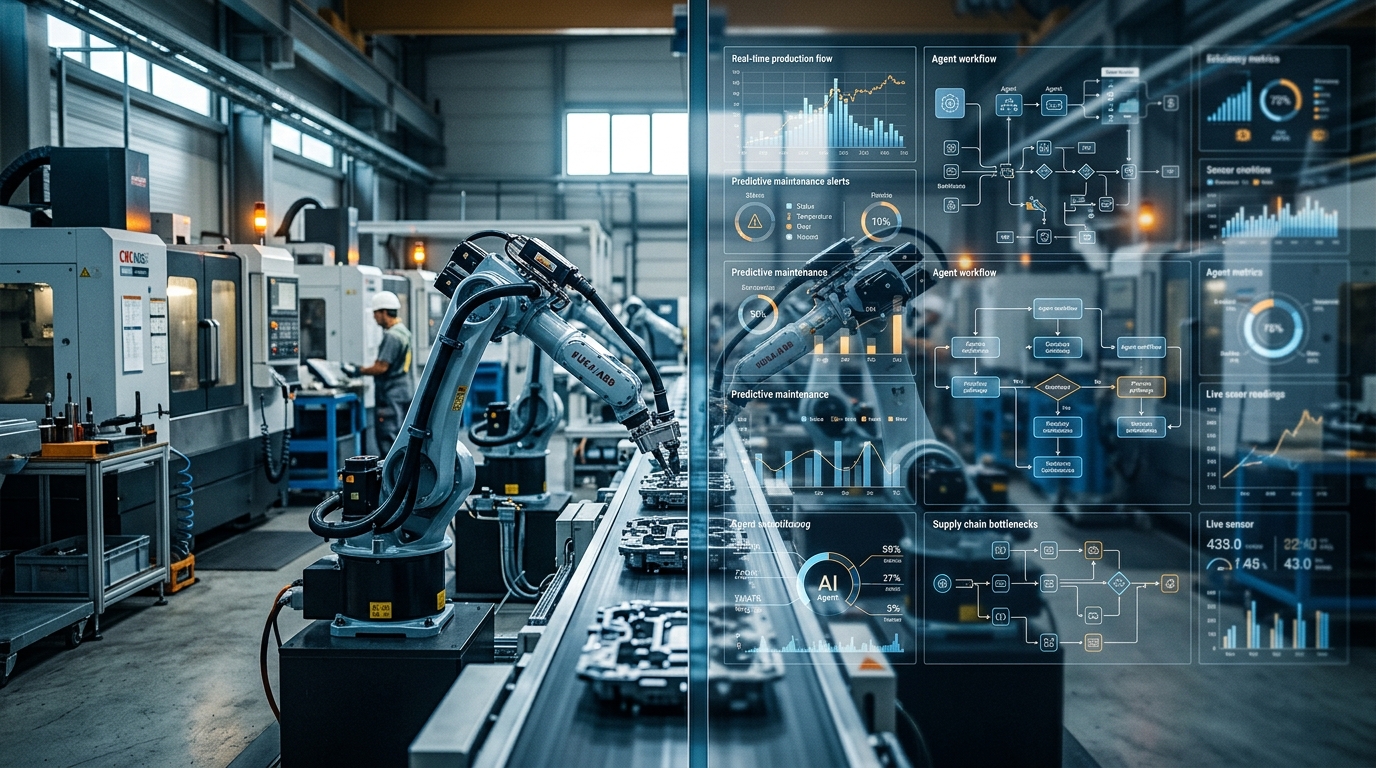
How agentic AI moves from decision support to autonomous execution in manufacturing and logistics. Real ROI and what breaks.
Last year the question for supply chain and manufacturing teams was whether AI could spot a disruption early enough to matter. In 2026, the question has shifted: can AI agents close the loop between detection and execution without waiting for a human to read a dashboard?
The answer is increasingly yes — and the gap between organizations that have figured this out and those still running pilot dashboards is widening fast.
The Decision-to-Execution Gap
Supply chains don’t break because of a lack of data. They break because the time between an anomaly appearing in the data and a corrective action being taken is measured in hours or days. A procurement exception flags in the ERP. Someone reads it, escalates it, schedules a call, negotiates an alternative, and updates the PO. By the time this loop completes, the production line has already shifted to sub-optimal material.
Agentic AI targets exactly this gap. Instead of alerting a human who then executes a correction, the agent detects the anomaly, evaluates alternatives against constraint rules, and executes the best available action — all within a bounded authority envelope and with an immutable audit trail. Microsoft described this shift explicitly in May 2026: agentic AI moves “from intelligence to impact by linking data, decisions, and execution across the supply chain.”
The data supports the urgency. IDC projects a 19% average ROI increase over traditional automation for supply chain AI deployments. Deloitte’s 2026 Manufacturing Industry Outlook reports that 80% of manufacturing executives plan to invest in agentic AI by end of year, with a survey of 600 executives confirming the priority.
Where Agents Are Actually Working
Predictive Maintenance — Autonomous, Not Advisory
The mature pattern looks like this: IoT sensors feed real-time vibration, temperature, and power consumption data into a model. When the model’s confidence exceeds a threshold — not just detecting an anomaly, but predicting a specific failure mode — the agent automatically:
- Creates a work order in the CMMS with the predicted failure type and component affected
- Checks parts availability and triggers a procurement request if the part isn’t in stock
- Schedules the maintenance window by negotiating with the production planning system for the lowest-impact slot
- Notifies the assigned technician with root cause analysis and recommended remediation steps
The distinction from traditional predictive maintenance systems is critical: older systems stopped at step zero (the alert). The agent completes the loop.
Manufacturers deploying this report 20-40% reductions in unplanned downtime and a 15-25% decrease in maintenance costs by shifting from calendar-based to condition-based interventions with automated execution.
Supply Chain Orchestration — Multi-Agent, Not Single Model
The supply chain use case that’s proving hardest — and most valuable — involves multiple agents coordinating across functions rather than a single agent optimizing a single variable:
- A procurement agent monitors raw material prices, supplier reliability scores, and geopolitical risk indicators. When a supplier’s risk score crosses a threshold, it evaluates alternatives against cost, lead time, and quality specifications.
- A logistics agent routes shipments dynamically based on weather disruptions, port congestion data, and carrier capacity. It re-routes in real time and renegotiates carrier contracts within pre-approved cost bands.
- An inventory agent balances stock levels across distribution centers, optimizing for service level targets while minimizing carrying cost. It triggers automated replenishment orders when forecasted demand exceeds available stock.
- A production planning agent adjusts schedules based on the inputs from all three — material availability, inbound logistics, and demand signals.
Maersk and DHL have both deployed AI-driven scenario analysis across service schedules, dwell times, and carbon trade-offs, treating these as coordinated agent workflows rather than siloed optimization dashboards. Unilever runs climate-aware demand forecasting that automatically adjusts production schedules based on weather-driven consumption pattern shifts.
This is where the multi-agent architecture from our production orchestration guide becomes operational reality rather than theoretical design.
Quality Control and Compliance
Computer vision systems have been doing defect detection for years. The agentic layer adds automated root cause analysis and corrective action:
- A vision system identifies a defect pattern on a production line
- An agent correlates the defect with machine parameters from the last 4 hours of operation, identifying the specific setting deviation responsible
- The agent adjusts machine parameters in real time or flags a maintenance request if the deviation is hardware-related
- Simultaneously, the agent generates a quality incident report pre-populated with defect images, machine parameters, and corrective actions taken
In regulated manufacturing (pharmaceuticals, aerospace, medical devices), compliance documentation is the bottleneck that prevents rapid iteration. Agents that can generate audit-ready documentation as a byproduct of normal operations remove friction from compliance workflows.
Production Scheduling and Energy Optimization
Advanced production scheduling tops the investment priority list at 38% of manufacturers planning near-term AI deployment, according to the 2026 Phantasma manufacturing survey. Energy monitoring and optimization ranks at 40%. The agent pattern here is straightforward but powerful:
An agent ingests orders, material availability, machine availability, maintenance windows, energy pricing, and carbon constraints. It produces a schedule that maximizes throughput while minimizing energy cost — and can re-optimize when any variable changes. In energy-intensive industries (steel, cement), this optimization alone can justify the agent deployment.
The ROI That Actually Shows Up
For organizations that reach production deployment, the numbers are concrete:
- Manufacturing: Companies shipping AI into production report a 34% average increase in production efficiency and 34% increase in supply chain efficiency (Deloitte 2025 survey of 600 executives).
- Logistics: 35% of logistics firms actively deploy AI with verified ROI gains averaging 19% improvement over traditional automation approaches.
- Quality: Vision-based inspection agents reduce defect escape rates by 40-60% compared to manual inspection, with the additional benefit of consistent application — no fatigue degradation.
These numbers are not theoretical pilot projections. They come from organizations running agents in production with documented outcomes.
What Breaks First
The deployments that fail share a common pattern: they architect the agent before they architect the data.
No Single Source of Truth
Manufacturing data lives in MES systems, ERP databases, PLC controllers, CMMS platforms, and spreadsheets maintained by engineers who’ve left. If an agent can’t resolve whether “Machine 7B” in the MES is the same asset as “CNC-007B” in the maintenance system, it can’t make decisions that span both systems. Organizations that succeed invest in data ontologies and asset registries before they deploy agents.
Latent Safety Constraints
An agent authorized to adjust machine parameters needs to know not just the safe operating range, but the constraints imposed by the current product being manufactured, the maintenance status of the machine, and any temporary safety protocols. Missing any of these inputs creates risk that no confidence threshold can eliminate.
Legacy System Integration
The Model Context Protocol (MCP) is gaining adoption as a standardization layer, but it doesn’t help you integrate with a 25-year-old SCADA system that speaks Modbus and has no REST API. The manufacturing and logistics sectors are defined by brownfield environments. Agent deployments that assume greenfield infrastructure fail at the integration layer.
The Human-in-the-Loop Question
On factory floors and in logistics operations, the handoff between agent autonomy and human decision-making is safety-critical. An agent that can autonomously reroute shipments needs different guardrails than an agent that can autonomously adjust a heat treatment process. The organizations getting this right implement graduated autonomy — different permission levels for different agent types, with escalation paths that are tested as rigorously as the agent’s primary logic.
What Production-Grade Looks Like in This Vertical
Based on the deployments that are working, we see a consistent pattern:
Data foundation first: Ontology mapping, asset registries, and data quality monitoring deployed before agents. This is the boring infrastructure that nobody demos. It accounts for 60-70% of project time. It’s also the difference between working and failing.
Graduated autonomy agents: Procurement agents that can reorder materials up to a spending cap without approval but escalate above it. Maintenance agents that can adjust soft parameters but never hard safety limits. Logistics agents that can re-route within a geographic region but require human approval for cross-border changes.
Agent-to-agent protocols: When your procurement agent, logistics agent, and production planning agent are all making decisions, they need a communication protocol that’s more structured than natural language prompts. The principles from our AI agent protocol stack analysis apply directly here.
Immutable audit trails with regulatory framing: In manufacturing and logistics, audit requirements aren’t optional. Every agent decision needs to be traceable, reversible, and explainable to an auditor who doesn’t care how the agent works.
Observability for physical-world feedback loops: Unlike a software-only agent, a manufacturing agent exists in a physical environment. Its decisions have measurable physical consequences. Teams that deploy telemetry comparing predicted outcomes against physical reality catch model drift before it becomes a production issue.
The Window Is Real and Narrowing
Gartner’s forecast that 40% of enterprise applications will embed task-specific agents by end of 2026 applies here with specific force. The manufacturing and supply chain sectors are not early-adopter industries — by definition, they wait for proven deployments. When they move, the adoption curve is steep.
Deloitte projects that 75% of companies will invest in agentic AI by end of 2026 — and the vendors serving manufacturing and logistics are already in that number. The competitive dynamic is not about who has the best agent architecture. It’s about who has the data foundation, safety protocols, and integration layer to put agents in production before their competitors do.
The organizations that win in this vertical are the ones treating agentic AI as a data architecture problem, not an AI model problem. They resolve asset identity across systems before they build agents that need that identity. They define agent authority boundaries before they grant autonomy. They instrument physical feedback loops before they scale.
That’s the unglamorous path to production. It’s also the one that actually works.
For broader enterprise adoption context, see our state of AI agents in enterprise analysis. For the multi-agent infrastructure patterns discussed in this post, see our production orchestration infrastructure guide.
Related Posts

State of AI Agents in Enterprise: Adoption Trends and Barriers in 2026
51% of enterprises run AI agents in production. 88% of projects never get there. The 2026 ROI numbers and what separates deployments that scale.

Enterprise AI Agent ROI: The 2026 Reality Check
88% of agent pilots never reach production. Of those that do, 19% never pay back. Here is what the 2026 data says about real agent ROI.
Enterprise Platforms Go Agent-Native: May 2026
Salesforce Headless 360, Okta's agent identity, Microsoft ADK 1.0, and Google Java ADK signal a structural shift.