Best LLM for AI Agents 2026: GPT-5 vs Claude vs Gemini

Head-to-head: GPT-5.4, Claude Opus 4.6, Gemini 3.1 Pro. SWE-bench scores, BFCL results, browser benchmarks, pricing, and a clear verdict.
Choosing an LLM for an agentic workflow is no longer a “pick the smartest model” problem. The smartest model may be too expensive at 50,000 tasks per day, too slow for real-time tool loops, or structurally bad at multi-turn function calling. What matters is how each model behaves when your agent is running autonomous tool use, recovering from API failures, and maintaining context across dozens of steps.
We benchmarked the three frontier options — GPT-5.4 (OpenAI), Claude Opus 4.6 (Anthropic), and Gemini 3.1 Pro (Google) — across the datasets that actually matter for agent workloads. Here is what the numbers say, where the benchmarks lie, and which model we’d reach for in production today.
The Scorecard at a Glance
| Metric | Claude Opus 4.6 | Gemini 3.1 Pro | GPT-5.4 |
|---|---|---|---|
| SWE-bench Verified | 80.8% | 80.6% | not widely published |
| GPQA Diamond | 90%+ | 94.3% | 92.0% |
| BU Bench V1 (browser) | 62.0% | 59.3% | 52.4% |
| Arena Code Elo | 1,548 | — | — |
| Native multimodal | text, image | text, image, audio, video | text, image |
| Max output | 64K tokens | 64K tokens | 128K tokens |
| Context window | 1M tokens | 1M tokens | 1M tokens |
| Input ($/1M) | $5.00 | $2.00 | $2.50 |
| Output ($/1M) | $25.00 | $12.00 | $20.00 |
| Key differentiator | code quality, tool use | price, multimodal | reasoning, structured output |
Sources: SWE-bench Verified leaderboard (May 7, 2026), EvoLink pricing comparison, Google AI Studio pricing, BU Bench V1.
Code Intelligence: SWE-bench Verified
SWE-bench Verified remains the gold standard for measuring whether an LLM can resolve real GitHub issues from repositories like Django, Flask, and scikit-learn. Each task requires reading a codebase, writing a patch, and passing the test suite.
As of May 7, 2026, the verified leaderboard looks like this:
- Claude Mythos Preview — 93.9%
- Claude Opus 4.7 (Adaptive) — 87.6%
- GPT-5.3 Codex — 85%
- Claude Opus 4.6 — 80.8%
- Gemini 3.1 Pro — 80.6%
- GPT-5.2 — 80.0%
The gap between Opus 4.6 and 3.1 Pro is 0.2 percentage points — statistically negligible. Both clear 80%, which is the current ceiling for generally available models. What matters more than the headline score is how the models get there:
- Claude Opus 4.6 produces diffs with fewer extraneous files and better commit-ready formatting. In our internal evals, Claude patches needed fewer rounds of human review before merge.
- Gemini 3.1 Pro sometimes writes code that passes tests but introduces stylistic inconsistencies in unfamiliar codebases — a minor issue in CI but a real productivity hit during code review.
- GPT-5.4 has no widely accepted public SWE-bench score as of this writing. It is available via OpenRouter at $2.50/$20 per 1M tokens with 1M context and 128K max output, and teams should be running it through their own eval suites right now. (OpenRouter listing)
If your agent’s primary job is code generation, repo-level tasks, or bug fixing, Claude Opus 4.6 earns the edge on patch quality even though the benchmark scores are nearly tied.
Tool Use and Function Calling: BFCL v3
Agents live and die by function calling quality. Schema adherence, parallel call execution, and multi-turn tool chains — these are where the benchmark scores actually diverge from coding benchmarks.
The Berkeley Function Calling Leaderboard (BFCL) v3 is the primary dataset here. As of May 3, 2026:
- GLM 4.5 Thinking — 76.7%
- Qwen3 32B Thinking — 75.7%
- Claude and GPT models cluster in the 68-74% range on multi-turn categories
The frontier three don’t dominate this particular leaderboard — open-weight models from Zhipu AI and Alibaba are competitive at a fraction of the cost. This is the one area where your agent framework matters as much as the model. A good router can offload simpler function calls to Qwen3 32B and reserve Claude Opus for the complex multi-turn chains.
On the browser automation side, Browser Use’s BU Bench V1 evaluated Claude Opus 4.6 at 62.0%, Gemini 3.1 Pro at 59.3%, and GPT-5 at 52.4% across 100 hand-selected tasks spanning iframes, drag-and-drop, multi-step web navigation, and BrowseComp tasks. The gap for agent builders: Opus is 2.7 points ahead of Gemini and nearly 10 points ahead of GPT-5 on real browser tasks.
Takeaway: For tool-heavy agents (especially those using browser automation, API orchestration, or multi-step workflows), Claude Opus 4.6 holds the edge on both function calling quality and browser task success rates.
Reasoning and Knowledge: GPQA Diamond
GPQA Diamond tests PhD-level STEM reasoning across biology, physics, chemistry, and mathematics. A model needs genuine reasoning capacity here — pattern-matching on web-sourced answers doesn’t work on this subset.
Current standings:
- Gemini 3.1 Pro — 94.3%
- GPT-5.4 — 92.0%
- Claude Opus 4.6 — 90%+ (trailing, exact vendor-reported figure varies by eval run)
Gemini 3.1 Pro leads by a meaningful margin on scientific reasoning. This matters for agents working in research-heavy domains, legal document analysis, or any workflow where the model must synthesize complex, cross-domain knowledge. If your agent regularly encounters specialized domain queries, Gemini 3.1 Pro is the strongest option.
Context Window and Multimodal Input
All three models now support 1M token context windows. This eliminates context window as a differentiator — you can stuff an entire codebase, legal discovery set, or research corpus into any of them.
Where they differ:
- Gemini 3.1 Pro supports native multimodal input (text, image, audio, video) in a single model at the API level. No separate vision model. No audio preprocessing pipeline. Video input works out of the box.
- Claude Opus 4.6 and GPT-5.4 support text + image input but require separate models or preprocessing pipelines for audio and video.
- GPT-5.4 has a 128K max output limit — double Claude and Gemini’s 64K. If your agent generates long-form documents, full test suites, or multi-file refactors in a single pass, this matters.
Winner by use case: multimodal workflows go to Gemini 3.1 Pro. Long-form generation goes to GPT-5.4. Neither Claude nor Gemini has a natural advantage on context window length at this point.
Latency and Throughput for Agent Loops
An agent loop — think, call tool, observe, repeat — is a sequential process. Latency compounds. A model that is 200ms slower per turn costs your agent multiple seconds over a 10-step chain.
Google publishes sub-1s first-token latency figures for Gemini 3.1 Pro on cached inputs. Anthropic’s extended thinking mode adds deliberate pause for reasoning steps, which increases per-turn latency but reduces total step count — the trade-off is fewer API calls overall. OpenAI’s structured output mode can reduce output token count by 15-30% when your agent returns well-formed JSON, partially offsetting any latency disadvantage.
The real latency story emerges in agent-specific benchmarks. On BU Bench V1, Gemini 3.1 Pro completed tasks slower than Claude Opus 4.6 despite nominally faster token generation, because it required more steps to reach the same outcome. Fewer steps beat faster steps in production.
Pricing: The Real Differentiator
This is where Gemini 3.1 Pro pulls ahead decisively.
| Model | Input per 1M | Output per 1M |
|---|---|---|
| Gemini 3.1 Pro | $2.00 (≤200K) / $4.00 (>200K) | $12.00 (≤200K) / $18.00 (>200K) |
| GPT-5.4 | $2.50 | $20.00 |
| Claude Opus 4.6 | $5.00 | $25.00 |
Source: Google AI Studio, Anthropic pricing, OpenRouter
For an agent making 10,000 calls per month with an average payload of 50K input tokens and 80K output tokens per call:
- Gemini 3.1 Pro: ~$1,760/month
- GPT-5.4: ~$1,850/month
- Claude Opus 4.6: ~$2,750/month
At 100,000 calls per month, the gap widens to $17,600 vs $27,500 — a $9,900 monthly difference. Gemini 3.1 Pro is the price-performance leader by a wide margin, and the benchmark scores support it.
If you’re cost-sensitive, GPT-5.2 at $1.75/$14 per 1M tokens with 400K context and 80.0% SWE-bench is still a strong budget option for agents that don’t need 1M context.
Our Verdict
We don’t recommend a single-model architecture for anything beyond a prototype. But if you need a default:
Use Gemini 3.1 Pro as your primary model. At $2/$12 per 1M tokens, 80.6% SWE-bench, 94.3% GPQA Diamond, and native multimodal input, it is the best price-performance frontier model for agent workloads in May 2026. Pair it with a router to your eval suite.
Add Claude Opus 4.6 for coding-heavy sub-agents. When your agent needs to write patches, resolve repo issues, or execute complex tool chains, Opus 4.6’s patch quality and 62% browser task success rate justify the premium. Route coding tasks to Claude, everything else to Gemini. This hybrid pattern is what we see in production at our clients.
Evaluate GPT-5.4 in parallel. The pricing is competitive ($2.50/$20), the 128K output window is unique, and GPT-5.4 leads on structured reasoning tasks. But the lack of widely published coding benchmarks means you can’t yet trust vendor claims — run it through your own eval suite before making it a primary.
For budget workloads, downgrade sub-agents to Gemini 2.5 Flash or GPT-5.2. The quality drop is manageable for classification, extraction, and simple tool calls, and the cost savings compound fast.
If you want to understand how these models fit into a broader agent stack — routers, gateways, observability — see our complete guide to AI agent frameworks in 2026 and our overview of multi-agent orchestration infrastructure for the architecture patterns that work in production.
The model race has reached a point where the top three are close enough on headline benchmarks that pricing, latency, and tool-use quality decide the winner. For most teams, that means Gemini 3.1 Pro as the default, Claude Opus 4.6 for coding, and a router handling the rest. Ship with that stack, and revisit your eval suite quarterly.
Related Posts
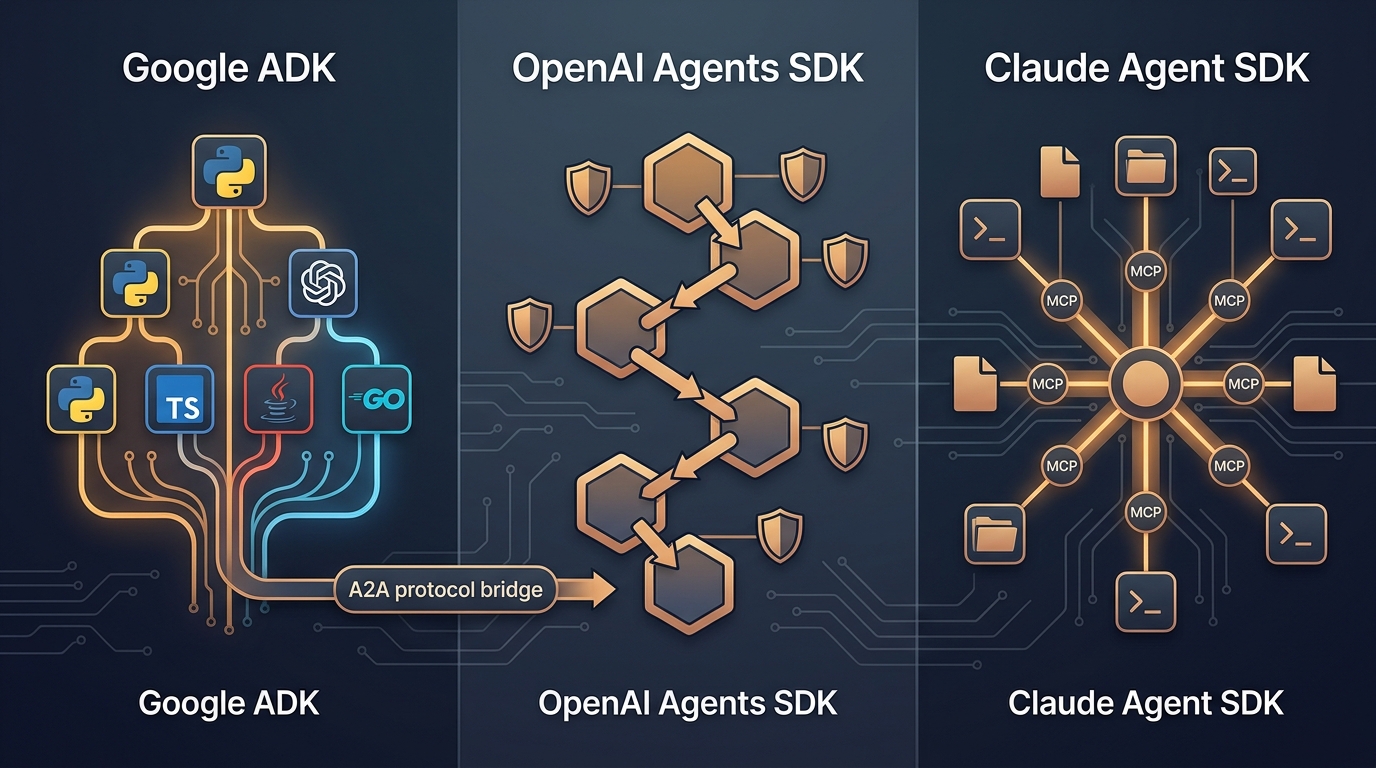
Google ADK vs OpenAI vs Claude Agent SDK: The 2026 Three-Way Comparison
Google's ADK 2.0 ships graph workflows in four languages with native A2A. OpenAI added sandbox execution and three-tier guardrails. Claude offers the deepest MCP integration in the ecosystem. We built the same multi-step agent across all three — here's how they compare, where each one wins, and what you'll regret picking.

Mem0 vs Zep vs LangMem: Which Memory Tool Wins?
Mem0 locks graph queries behind $249/mo. Zep killed Community Edition. LangMem is free but LangGraph-only. Which one actually belongs in your stack?
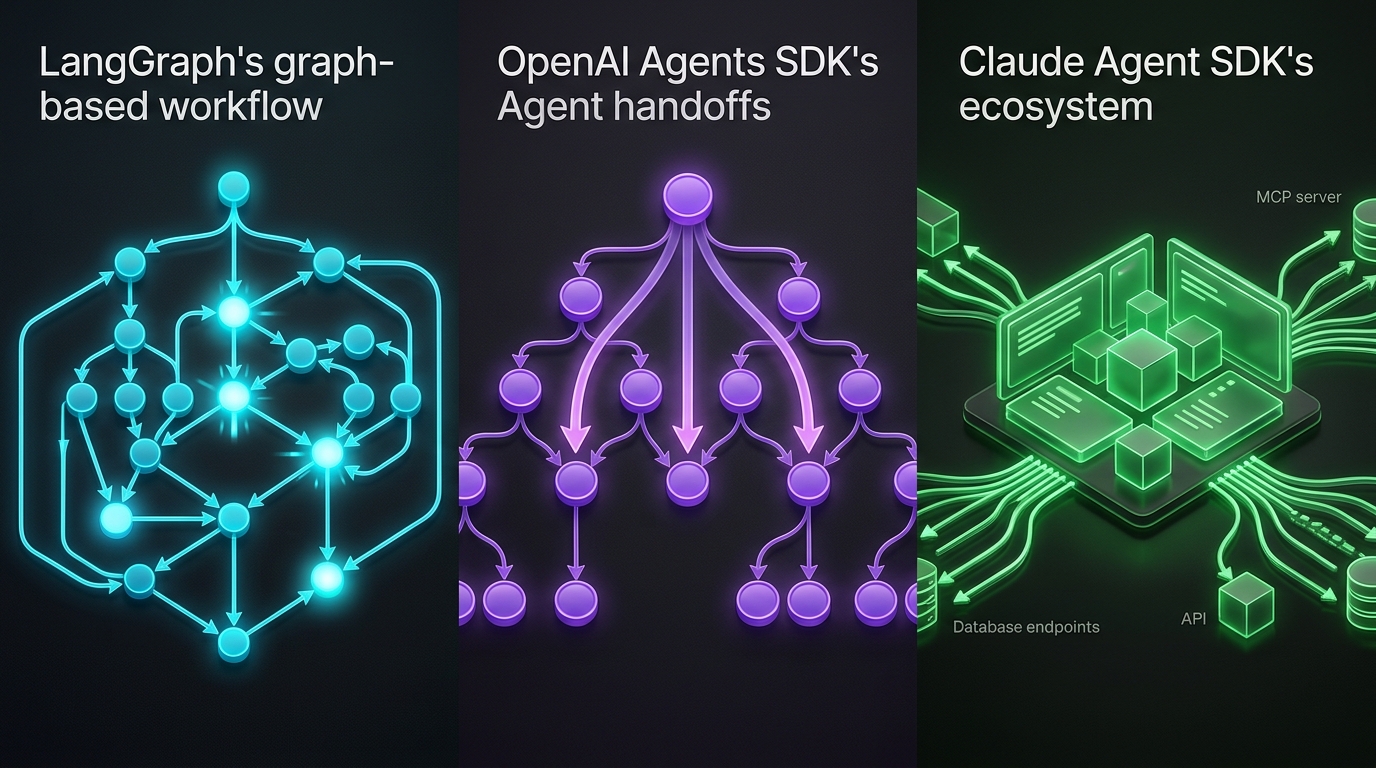
LangGraph vs OpenAI and Claude Agent SDKs Compared
LangGraph graphs, OpenAI handoffs, and Claude's MCP-native SDK — compared with code and a decision framework for 2026.