Google ADK vs OpenAI vs Claude Agent SDK: The 2026 Three-Way Comparison
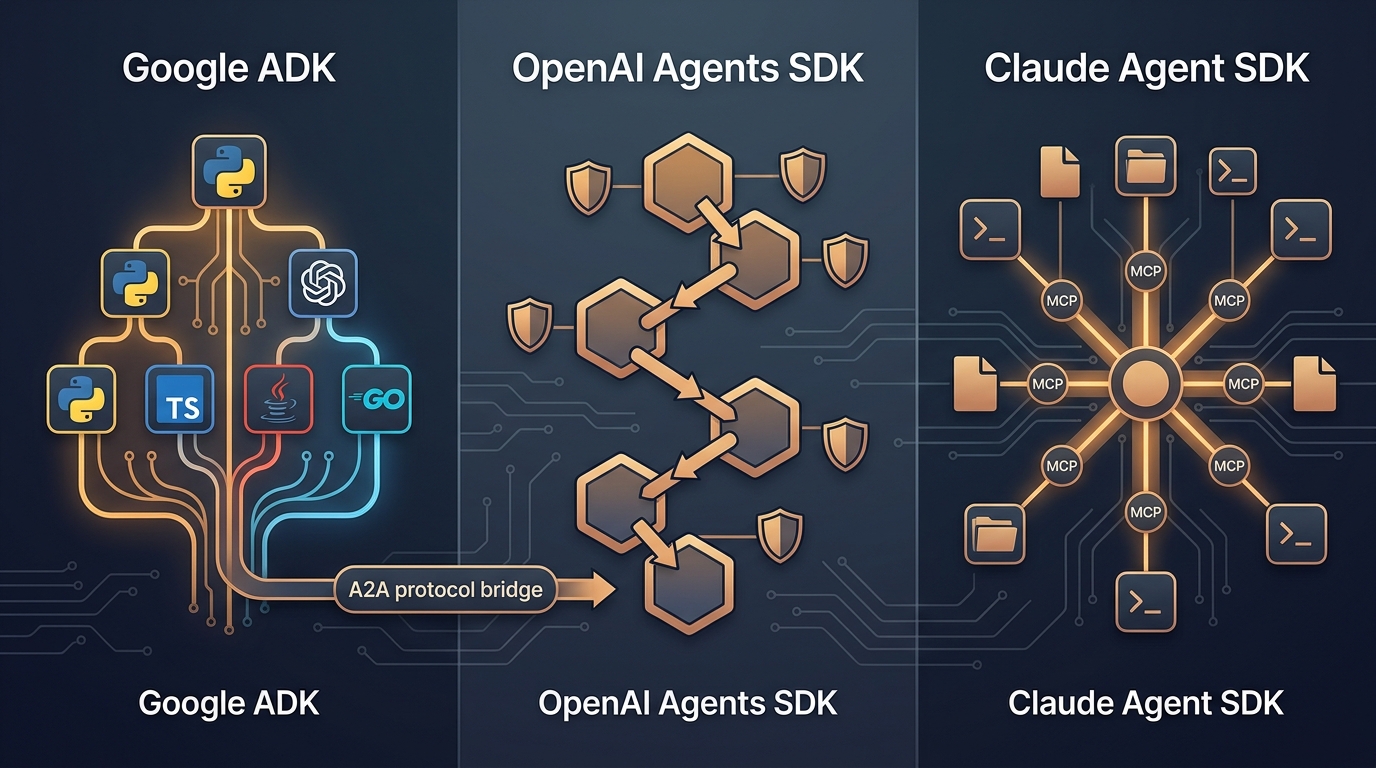
Google's ADK 2.0 ships graph workflows in four languages with native A2A. OpenAI added sandbox execution and three-tier guardrails. Claude offers the deepest MCP integration in the ecosystem. We built the same multi-step agent across all three — here's how they compare, where each one wins, and what you'll regret picking.
Every major AI lab now ships an agent SDK. Google launched ADK 2.0 with graph workflows and collaborative agent teams. OpenAI’s Agents SDK added sandbox execution, voice support, and three-tier guardrails. Anthropic renamed Claude Code SDK to Claude Agent SDK and kept pushing MCP deeper than anyone else.
The question isn’t whether to use an SDK — it’s which one, and whether you’ll regret the choice six months into production.
We built the same multi-step agent — research → analysis → report — across all three SDKs. This comparison covers architecture, multi-agent coordination, production readiness, and the lock-in each SDK imposes. We’ll show real code and note the sharp edges we hit.
If you need the short version: Google ADK wins for multi-language enterprise teams and A2A interoperability. OpenAI wins for lightweight handoff chains and rapid prototyping. Claude wins for deep OS-level agents and the richest MCP ecosystem.
The Mental Model: What Each SDK Actually Is
Before comparing features, you need to understand what each SDK wants to be. The most common mistake teams make is treating them as drop-in substitutes. They aren’t.
| Dimension | Google ADK | OpenAI Agents SDK | Claude Agent SDK |
|---|---|---|---|
| What it is | Multi-language agent framework with graph engine | Lightweight handoff system with guardrails | OS-native agent platform |
| Languages | Python, TypeScript, Java, Go, Kotlin | Python, TypeScript | Python, TypeScript |
| Coordination model | Hierarchical trees + graph workflows | Linear handoff chains | Subagents + hook lifecycle |
| Model scope | Model-agnostic (Gemini-optimized) | OpenAI models only | Claude models only |
| Protocols | Native A2A, MCP via adapters | MCP tool support | Native MCP (deepest) |
| Deployment | Vertex AI, Cloud Run, GKE, agent runtime | OpenAI platform | Self-hosted or via API |
| Best mental model | ”Agent development should feel like software development" | "Agents delegate to agents via typed handoffs" | "Give the agent a computer” |
Provider-native SDKs lock you to one model family. That’s not necessarily a problem — many teams standardize on a single provider. But if you need model flexibility, Google ADK has a clear advantage: it’s model-agnostic and supports Gemini, Claude, Ollama, vLLM, and LiteLLM out of the box. It’s optimized for Gemini, not locked to it.
Google ADK: What Makes It Different
Google ADK launched as an open-source, code-first Python toolkit and has since grown into a five-language framework. ADK 2.0 shipped in April 2026 with two major additions: graph-based workflows and collaborative agent teams.
Graph workflows — determinism where you need it
ADK 2.0’s graph engine is the biggest differentiator. Unlike OpenAI’s linear handoff chains or Claude’s subagent spawning, ADK lets you define explicit routing logic between nodes. This matters when you need deterministic branching — if-this-then-that logic that doesn’t rely on an LLM to decide which direction to take.
from google.adk import Agent, GraphWorkflow

graph = GraphWorkflow()

@graph.node("researcher")
def research_node(state):
    # LLM-powered research step
    result = state.agent.run("Research the given topic")
    state.data["research"] = result
    return "analyzer"  # Deterministic routing

@graph.node("analyzer")
def analyze_node(state):
    analysis = state.agent.run(f"Analyze: {state.data['research']}")
    state.data["analysis"] = analysis
    # Dynamic routing based on analysis quality
    if state.data.get("needs_more_research"):
        return "researcher"
    return "writer"

@graph.node("writer")
def writer_node(state):
    return state.agent.run(f"Write report from: {state.data['analysis']}")

graph.add_edge("researcher", "analyzer")
graph.add_edge("analyzer", "writer")
graph.add_edge("analyzer", "researcher")  # Loop for refinement
The key difference from LangGraph: ADK’s graph engine treats agents as nodes, not just LLM calls. Each node runs a full agent loop with its own tools and instructions. This gives you LangGraph-style determinism without giving up the rich agent primitives.
Four languages, one protocol
Google ADK ships Java 1.0, Go 1.0, and Kotlin SDKs alongside Python and TypeScript. This matters for enterprise teams where backend services run on JVM or Go — your agent logic lives in the same language and repo as the rest of your stack. No FastAPI sidecar bolted onto a Spring Boot monolith.
The A2A protocol is what makes multi-language teams work. ADK’s to_a2a() function auto-generates an Agent Card — a JSON capability description — from any ADK agent. A Python research agent discovers a Java compliance agent via its Agent Card, and they communicate through typed A2A messages without either side knowing the other’s language.
# Python agent exposing itself via A2A
from google.adk import Agent

research_agent = Agent(
    name="researcher",
    model="gemini-2.5-pro",
    instruction="Research topics and return structured findings.",
    tools=[web_search, document_fetch]
)

# Auto-generated Agent Card for discovery
agent_card = research_agent.to_a2a()
This is a fundamentally different approach from OpenAI’s handoffs or Claude’s subagents. Those are internal coordination models — they work within a single process, single language, single deployment. A2A is designed for cross-process, cross-language, cross-vendor communication. Google co-authored the A2A spec with over 50 industry partners and contributed it to the Linux Foundation.
Where ADK falls short
The deployment story is heavily Google Cloud. ADK deploys to Vertex AI Agent Engine, Cloud Run, or GKE — all solid options, but you’re deep in the Google ecosystem. The local agent runtime (adk run) works well for development, but production deployment outside Google Cloud requires more manual infrastructure work than OpenAI or Claude, where the SDKs run wherever your Python process runs.
MCP support is through adapters rather than native. Google’s team is clearly betting on A2A as the long-term protocol layer (they’re not alone — ACP merged into A2A under the Linux Foundation earlier this year), but the MCP ecosystem has 200+ server implementations today. If you need Playwright, Slack, GitHub, and Google Drive via MCP, Claude’s SDK handles that in a single line of config. ADK requires more wiring.
OpenAI Agents SDK: Clean Handoffs, Strong Guardrails
OpenAI’s Agents SDK is the simplest of the three. It has the fewest abstractions and the gentlest learning curve. The core loop: create Agent objects with instructions and tools, run them with Runner.run(), and let them hand off to other agents when they need help.
Three-tier guardrails running in parallel
Guardrails are where OpenAI’s SDK stands out. Three types run automatically: input guardrails validate user messages before the agent sees them, output guardrails check final responses, and tool guardrails wrap individual tool calls. All three run in parallel with agent execution by default. If any guardrail trips, execution halts immediately.
from agents import Agent, Runner, input_guardrail, GuardrailFunctionOutput

@input_guardrail
def pii_detector(messages, context):
    # Check for PII in user input
    if contains_pii(str(messages)):
        return GuardrailFunctionOutput(
            output_info="PII detected",
            tripwire_triggered=True
        )
    return GuardrailFunctionOutput(tripwire_triggered=False)

support_agent = Agent(
    name="support",
    instructions="Help users with account questions.",
    input_guardrails=[pii_detector],
    tools=[lookup_account, reset_password]
)
Claude’s SDK has hooks that serve a similar purpose (pre-tool, post-response, error hooks), but guardrails are more opinionated: they’re designed to block unsafe behavior, not just observe it. In regulated environments, this difference matters.
Linear handoffs — elegant but limited
OpenAI’s handoff model is the cleanest in the ecosystem: when Agent A delegates to Agent B, it executes transfer_to_agent_b as a typed tool call. The conversation history travels with the handoff. No shared state bus. No message queues.
from agents import Agent, handoff

billing_agent = Agent(
    name="billing",
    instructions="Handle billing inquiries.",
    tools=[check_balance, process_refund]
)

triage_agent = Agent(
    name="triage",
    instructions="Route user to the right specialist.",
    handoffs=[handoff(billing_agent)]
)
The limitation: handoffs are linear chains. If your workflow needs Agent A → Agent B → back to Agent A, or Agent A → Agent B and Agent C in parallel, OpenAI’s SDK requires you to model that manually. ADK’s graph engine and LangGraph’s state graphs handle cyclic and parallel routing natively.
Where OpenAI falls short
No built-in state persistence. You manage checkpointing yourself — store conversation state, resume sessions, recover from failures. In a long-running research agent, this matters. Claude’s SDK provides session-based persistence with custom session IDs. ADK provides built-in checkpointing through its graph engine.
Voice features lock you to OpenAI-specific models (gpt-realtime). If you want voice agents with Google or Anthropic models, you’ll need a different stack.
Claude Agent SDK: Deepest MCP, Best OS Access
Claude Agent SDK evolved from Claude Code. Its thesis is simple: give the agent a computer. File system access, shell commands, and web browsing are built-in tools, not custom wrappers.
MCP integration — the deepest in any framework
Claude’s SDK connects to 200+ MCP servers with single-line configuration. Slack, GitHub, Playwright, Google Drive — all available through a unified tool interface. No adapter layer, no translation. The SDK treats MCP servers as first-class tools.
from claude_agent_sdk import ClaudeAgentOptions, query

options = ClaudeAgentOptions(
    mcp_servers={
        "playwright": {"command": "npx", "args": ["@playwright/mcp"]},
        "github": {"command": "npx", "args": ["@anthropic/mcp-github"]},
        "slack": {"command": "npx", "args": ["@anthropic/mcp-slack"]}
    }
)

result = query(
    prompt="Check our GitHub issues labeled 'bug', summarize them, "
           "and post the summary to #eng-standup on Slack.",
    options=options
)
This is the SDK’s superpower. An agent that reads GitHub issues, browses documentation via Playwright, and posts to Slack — without writing custom tool wrappers — is a qualitatively different development experience. You think in capabilities, not in API integrations.
Hooks as a lifecycle control plane
Hooks intercept agent behavior at lifecycle points: before tool calls, after responses, on errors. They’re more flexible than OpenAI’s guardrails because they can transform behavior, not just block it.
from claude_agent_sdk import hook

@hook("pre_tool_call")
def validate_and_transform(tool_call):
    if tool_call.name == "Bash":
        # Transform: redirect dangerous commands to a read-only sandbox
        tool_call.args["command"] = sandbox_wrap(tool_call.args["command"])
    return tool_call

@hook("post_response")
def log_and_audit(response):
    audit_log.write(response.summary())
Where Claude falls short
Locked to Claude models. Period. If Anthropic has an outage or a model you need isn’t available via Claude, you’re rewriting. No A2A support means Claude agents can’t participate in cross-vendor agent discovery — you can’t have a Claude agent discover and delegate to a Gemini-powered agent via a standard protocol.
Python and TypeScript only. No Java, Go, or .NET. For enterprises with JVM monoliths, this means a separate service tier for agent logic.
Decision Framework: Which One Should You Pick?
Here’s the honest answer for four common scenarios. We’ve been wrong about framework choices before, so we’ll be specific about the trade-offs.
You’re a Java / Go enterprise team shipping multi-agent systems
Pick Google ADK. Four language SDKs with native A2A means your Python research agent discovers your Java compliance agent without translation layers. ADK 2.0’s graph engine gives you deterministic routing where you need it. The trade-off: you’re deep in Google Cloud for production deployment. If your org is already on GCP, this is a non-issue. If you’re on AWS, the deployment story requires more work.
You’re building customer service routing or triage pipelines
Pick OpenAI Agents SDK. The handoff model is purpose-built for this: triage → billing or triage → technical or triage → human. Guardrails give you compliance-grade input/output validation with minimal code. The trade-off: you manage state persistence yourself. For short-lived customer interactions, this barely matters. For long-running workflows, it eventually will.
You’re building coding agents, research agents, or anything that needs OS access
Pick Claude Agent SDK. Built-in file system, shell, and 200+ MCP servers mean you go from idea to working agent in hours, not days. Hooks give you lifecycle control that guardrails alone can’t match. The trade-off: Claude-only models. If your org standardizes on Claude, this isn’t a trade-off at all.
You need model flexibility and don’t want to pick a side
None of these — use LangGraph. All three provider SDKs optimize for their own models. LangGraph is the only framework that gives you full provider flexibility with production-grade state management and checkpointing. We covered this in our LangGraph vs OpenAI and Claude Agent SDK comparison.
The Lock-In Calculus
Every framework decision is a lock-in decision. The question is whether you’re locking into the right thing.
| SDK | You’re locked into… | Breaking free costs… |
|---|---|---|
| Google ADK | Google Cloud + Gemini optimization (not lock-in) | Port A2A agent cards to other runtimes |
| OpenAI Agents SDK | OpenAI models | Rewrite tool schemas for every tool call |
| Claude Agent SDK | Claude models + Anthropic ecosystem | Rewrite MCP server configs for other SDKs |
Google ADK’s lock-in is the softest: it’s model-agnostic but deployment-optimized for GCP. You can run it elsewhere, but you’ll miss the managed tooling.
OpenAI and Claude lock you to their models. For many teams, that’s fine — model quality differences between GPT-5, Claude 4, and Gemini 2.5 Pro are smaller than architectural fit differences. We’ve benchmarked the best LLMs for agents in 2026 — the gap between top-tier models is narrowing, making framework architecture a more important decision than model selection.
Where This Leaves Us
Provider SDKs are converging on the same feature set — tools, memory, multi-agent coordination — but from fundamentally different starting points. Google ADK treats agents as software components in a distributed system. OpenAI treats them as conversation handlers with delegation. Claude treats them as computer users with tool access.
The protocol layer is where real interoperability will emerge. A2A and MCP are converging into a unified stack under the Linux Foundation. If Google’s multi-language, A2A-native approach wins the protocol war, ADK’s architecture looks prescient. If MCP remains dominant, Claude’s SDK has the deepest integration. If neither wins decisively, LangGraph’s provider-agnostic approach remains the safest bet for teams that can’t afford to guess wrong.
For now, pick the SDK that matches your team’s stack and your deployment target. The framework matters less than the infrastructure underneath it — and 88% of agent pilots never reach production because teams underestimate that part.
Related Posts
LangGraph vs OpenAI and Claude Agent SDKs Compared
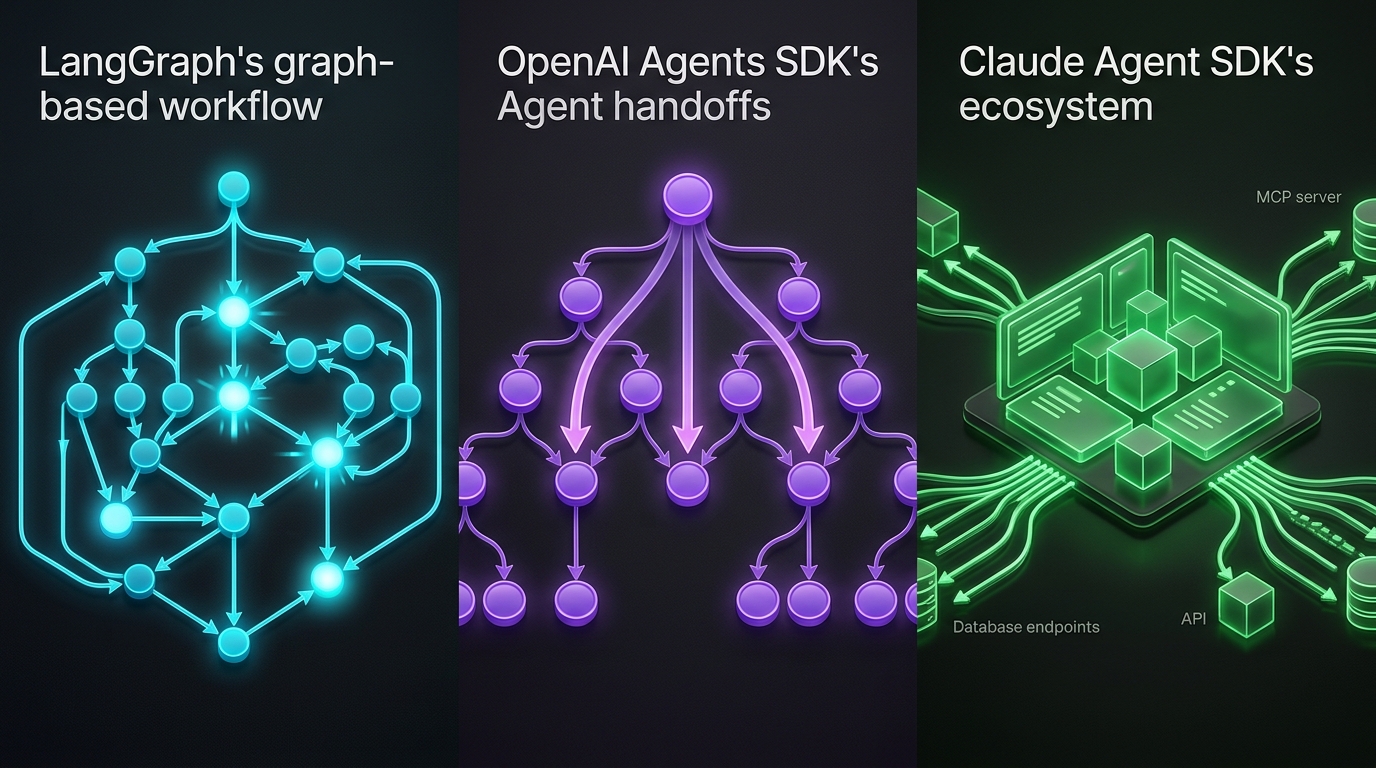
LangGraph graphs, OpenAI handoffs, and Claude's MCP-native SDK — compared with code and a decision framework for 2026.
OpenAI Agents SDK vs Claude Agent SDK: 2026 SDK Showdown
OpenAI added sandboxes and subagents. Claude Agent SDK brings MCP, tool search, and streaming. We built with both — here's the verdict.

OpenAI Assistants API vs Claude MCP: Two Approaches to Building AI Agents
A comprehensive comparison of OpenAI's Assistants API and Anthropic's Model Context Protocol (MCP) for building AI agents, covering architecture, integration patterns, and when to use each approach