OpenAI Agents SDK vs Claude Agent SDK: 2026 SDK Showdown
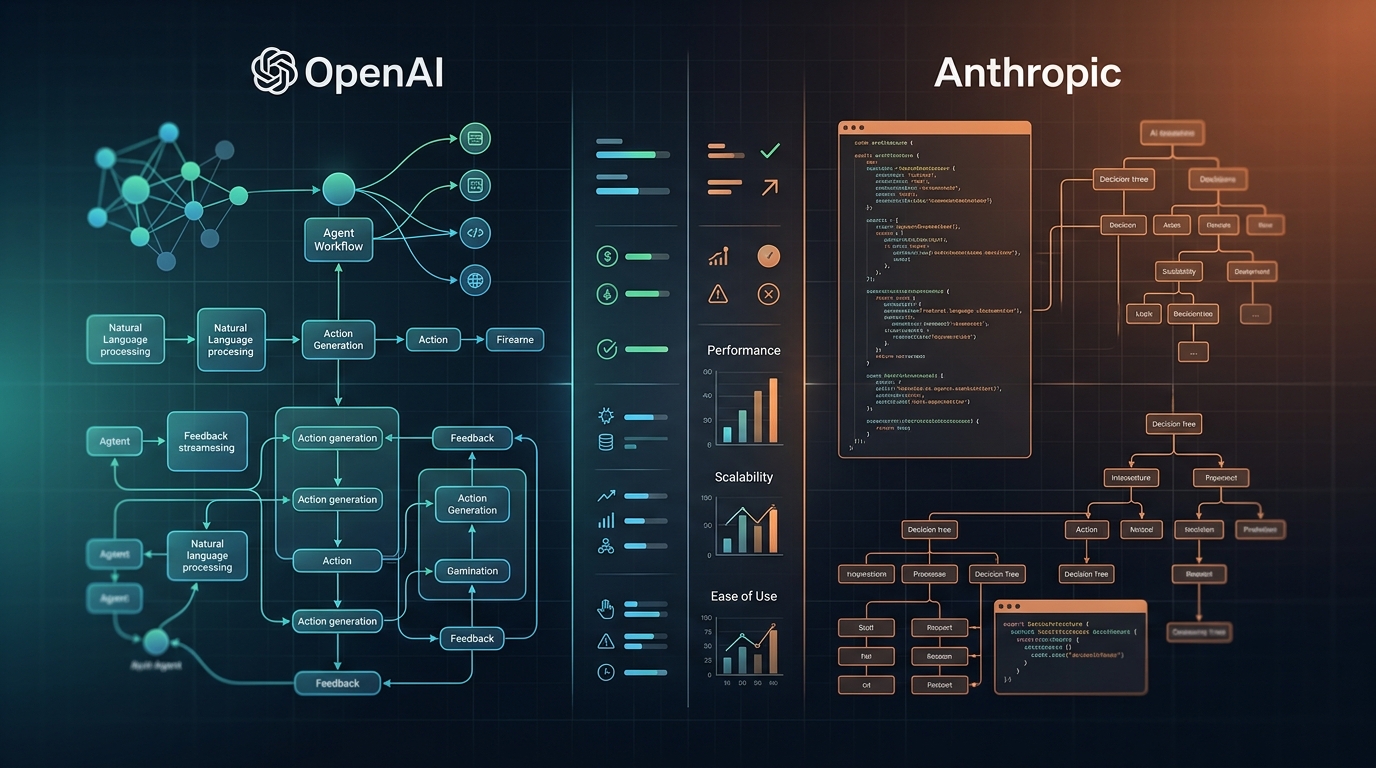
OpenAI added sandboxes and subagents. Claude Agent SDK brings MCP, tool search, and streaming. We built with both — here's the verdict.
When OpenAI shipped its Agents SDK overhaul in April 2026, it finally stopped treating agent-building as an afterthought to ChatGPT. Native sandbox execution, subagents, code mode, MCP primitives — the SDK transformed from a thin wrapper into a production harness for long-running agents. Meanwhile, Anthropic’s Claude Agent SDK has been maturing in parallel, offering MCP integration, tool search, structured outputs, and session management.
We’ve built production agents with both SDKs over the last six months. They share the same goal — make it easy to build agents that call tools, manage state, and chain multi-step workflows — but they get there in fundamentally different ways.
This comparison covers architecture, developer experience, production readiness, and the specific use cases where each SDK wins. If you need a quick answer, jump to the verdict section at the bottom.
Mental Model: What Each SDK Actually Is
The first mistake teams make is treating SDKs the same as orchestration frameworks like LangGraph or CrewAI. These are not graph engines or team orchestrators. They are agent primitives — the lowest-level building block for creating an LLM-backed entity that uses tools, maintains conversation history, and produces structured output.
| Dimension | OpenAI Agents SDK | Claude Agent SDK |
|---|---|---|
| Languages | Python, TypeScript | Python, TypeScript, CLI |
| Agent loop | Server-side Runner.run() with handoff | query() with streaming + hooks |
| Tool system | Built-in function calling + MCP | MCP, custom tools, tool routing |
| Multi-agent | Agent-to-agent handoffs + subagents | Subagents + session management |
| State | Agent-level message history | Session-based persistence |
| Model lock-in | OpenAI models only | Claude models only |
| Sandboxing | Native sandbox (April 2026 update) | Via MCP + shell tools |
Both SDKs are single-model ecosystems. You can’t swap GPT-4.1 for Claude Sonnet in the OpenAI SDK, and vice versa. This is a significant constraint if your agent routing requires model-agnostic fallback — something that LangGraph’s ChatModel abstraction handles natively. See our complete guide to AI agent frameworks for a broader landscape view.
OpenAI Agents SDK: Architecture & Key Features
Agent Handoffs and Subagents
The core abstraction is the Agent — an LLM wrapper with tools, instructions, and optional output schemas. Multi-agent workflows work through handoffs: one agent calls another agent as a tool, transferring the conversation context.
from agents import Agent, Runner, function_tool

@function_tool
def get_customer_account(account_id: str) -> dict:
    return {"account_id": account_id, "status": "active"}

@function_tool
def list_orders(account_id: str) -> list:
    return [{"order_id": "ORD-123", "total": 89.99}]

support_agent = Agent(
    name="Support Agent",
    instructions="You are a helpful customer support agent.",
    tools=[get_customer_account, list_orders],
    model="gpt-4.1",
    output_type=str,
)

router_instructions = """
Determine the user intent and hand off to the appropriate agent.
If they need account help, transfer to the support_agent.
If they need billing help, transfer to the billing_agent.
"""

router = Agent(
    name="Router",
    instructions=router_instructions,
    handoffs=[support_agent],
    model="gpt-4.1",
)

result = Runner.run(router, input="I need help with my account ORD-123")
print(result.final_output)
The April 2026 update added subagents, which are more structured than handoffs — a parent agent spawns child agents that run in parallel, each with isolated context, and results are aggregated back. This is the pattern that enables agents to inspect files, run commands, and edit code across multiple parallel tasks.
Code Mode and Sandboxes
The April 2026 release also introduced code mode (Python and TypeScript) and native sandbox execution. Agents now run inside controlled environments — they can access files, execute commands, and make edits without risk to the host system. This is critical for enterprise deployment where uncontrolled tool execution is a non-starter.
Handoff Tracing and Guardrails
OpenAI’s Guardrail API integrates directly with the SDK, allowing input and output validation at every handoff. For production deployments, this means you can enforce compliance checks between agents without adding middleware. LangGraph offers similar checkpointing granularity, as we covered in our LangGraph vs CrewAI vs AutoGen comparison.
Strengths:
- Production-grade sandboxing: The April 2026 sandbox is the only native sandbox in a major SDK. For any agent that touches code or the filesystem, this is non-negotiable in enterprise.
- Subagent parallelism: Run multiple independent agents and aggregate results. This pattern is essential for parallel research, code review across multiple files, or simultaneous API queries.
- Guardrails integration: Built-in input/output validation at the SDK layer.
- Clean handoff model: Agent-to-agent transfers are first-class and type-checked.
Weaknesses:
- Model lock-in: You buy into the OpenAI model family. No fallback to Anthropic or Google.
- No MCP native server: While OpenAI announced MCP support, the integration is less mature than Anthropic’s.
- No streaming by default:
Runner.run()returns the full result. Streaming exists but requires explicit handling.
Claude Agent SDK: Architecture & Key Features
Tool Search and MCP Integration
Anthropic approaches agent-building differently. The Claude Agent SDK is built on top of Claude Code’s capabilities, meaning it inherits a mature tool ecosystem from day one. The standout feature is tool search — when an agent has dozens of tools available, the SDK automatically filters and routes to the most relevant tools per turn, avoiding context window saturation.
from anthropic import Anthropic
from claude_code_sdk import ClaudeSDKClient

client = ClaudeSDKClient(
    api_key="your-api-key",
    model="claude-sonnet-4-20250514",
)

# The tool_search feature automatically selects relevant tools
# from your registered MCP servers and custom tools
async def run_agent(query: str):
    response = await client.query(
        input=query,
        tools=[
            "mcp:filesystem",  # MCP server for file operations
            "mcp:github",      # MCP server for GitHub operations
            "custom:deploy",   # Custom deployment tool
        ],
        stream=True,
    )

    async for event in response.events:
        if event.type == "text":
            print(event.data)
        elif event.type == "tool_use":
            print(f"Calling tool: {event.data.name}")
The MCP integration is native and mature — the SDK treats MCP servers as first-class tool sources, and any MCP-compliant tool is available to your agent without custom code. This is a significant advantage if your organization is building a tool ecosystem around MCP.
Sessions and Structured Outputs
Claude’s SDK manages sessions — persistent conversation contexts that span multiple turns. Combined with structured outputs, you can build agents that produce typed, parseable responses without needing an external schema library.
from pydantic import BaseModel

class DeploymentResult(BaseModel):
    status: str
    environment: str
    version: str
    deployed_at: str

response = await client.query(
    input="Deploy v2.4.1 to production",
    output_schema=DeploymentResult,
)
Streaming and Hooks
The agent loop supports real-time streaming of text and tool calls, with hook points for custom logic before and after each tool invocation. This is useful for logging, rate limiting, or injecting custom guardrails.
async def on_tool_use(event):
    # Log every tool call
    logger.info(f"Tool: {event.tool_name}, Args: {event.args}")
    return event  # Return modified or original event

client = ClaudeSDKClient(
    model="claude-sonnet-4-20250514",
    hooks={
        "before_tool_use": on_tool_use,
    }
)
Strengths:
- MCP-first tool integration: If your tool strategy is built on MCP, this is the best-in-class SDK. No competing SDK matches the depth of MCP support.
- Tool search: Automatic tool routing prevents context window exhaustion when agents have large tool registries.
- Streaming by default: Real-time output streaming is a first-class API surface.
- Session management: Built-in persistence across turns with session IDs.
- Model flexibility within Claude family: Swap Sonnet 4 for Opus 4 without code changes.
Weaknesses:
- No native sandbox: Sandboxing requires MCP servers with sandboxed tool implementations — it’s possible but not built-in.
- Smaller developer community: The SDK is newer and has fewer community examples and Stack Overflow threads.
- No handoff orchestration: Multi-agent workflows are more manual compared to OpenAI’s handoff model.
Head-to-Head: Where Each SDK Wins
Developer Experience
Winner: Claude Agent SDK
The Claude SDK’s streaming-first API, tool search, and MCP integration mean you spend less time wiring up infrastructure and more time defining agent behavior. The OpenAI SDK requires more boilerplate for handoffs and lacks built-in tool routing — you must manage which tools are active for each agent manually.
Production Safety
Winner: OpenAI Agents SDK
Native sandboxing is the deciding factor. If your agents read files, run commands, or deploy code, OpenAI’s sandbox is the only out-of-the-box solution. Getting equivalent safety with the Claude SDK requires building custom MCP tools with sandboxed execution — doable but adds weeks to your timeline.
Multi-Agent Workflows
Winner: OpenAI Agents SDK
OpenAI’s handoff model and subagent pattern are mature and explicit. You define which agents can transfer to which other agents, and subagents run in parallel with isolated context. The Claude SDK requires manual orchestration for multi-agent patterns — it’s an SDK for building single agents, not teams.
Tool Ecosystem
Winner: Claude Agent SDK
MCP is the future of agent tooling, and Anthropic is all-in. The Claude SDK’s tool search + native MCP server integration means agents can access thousands of community tools without custom code. OpenAI’s MCP support is still catching up.
Performance and Latency
Tie
Both SDKs introduce minimal overhead — they are thin wrappers around their respective APIs. Latency is dominated by model inference time, not SDK routing. For latency-critical applications, both offer streaming to reduce time-to-first-token.
Decision Matrix
| Your Scenario | Recommended SDK | Why |
|---|---|---|
| Enterprise sandboxed agents | OpenAI | Native sandbox + Guardrails |
| MCP-first tool ecosystem | Claude | Mature MCP + tool search |
| Multi-agent parallel workflows | OpenAI | Subagents + explicit handoffs |
| Single agent with tool calling | Claude | Simpler API + streaming |
| Need model flexibility | Neither | Use LangGraph or CrewAI instead |
| Code inspection/editing agents | OpenAI | Code mode + sandbox |
| Agent with structured outputs | Claude | Native output_schema support |
The Verdict
If you’re building enterprise agents that touch production systems — deploying code, accessing customer data, running shell commands — OpenAI Agents SDK is the right choice. The April 2026 sandbox update closes the last major gap for production deployments.
If you’re building tool-heavy agents that interact with APIs, databases, and developer tools — and your tool strategy is aligned with MCP — Claude Agent SDK gives you the best developer experience and the most mature tool ecosystem.
In practice, we see teams using both SDKs within the same architecture: OpenAI Agents SDK for customer-facing agents that need sandboxed execution, and Claude Agent SDK for internal developer tooling that leverages our MCP server fleet. If you need model-agnostic orchestration across both, pair them with LangGraph as the coordinator layer — we covered that pattern in our LangGraph vs CrewAI vs AutoGen comparison.
The real story of 2026 is that SDK vendors are finally converging on production-ready agent primitives. Sandboxing, structured outputs, MCP, and subagents are no longer experimental — they’re table stakes. The SDK that wins is the one that best matches your existing tool ecosystem and safety requirements.
Related Posts
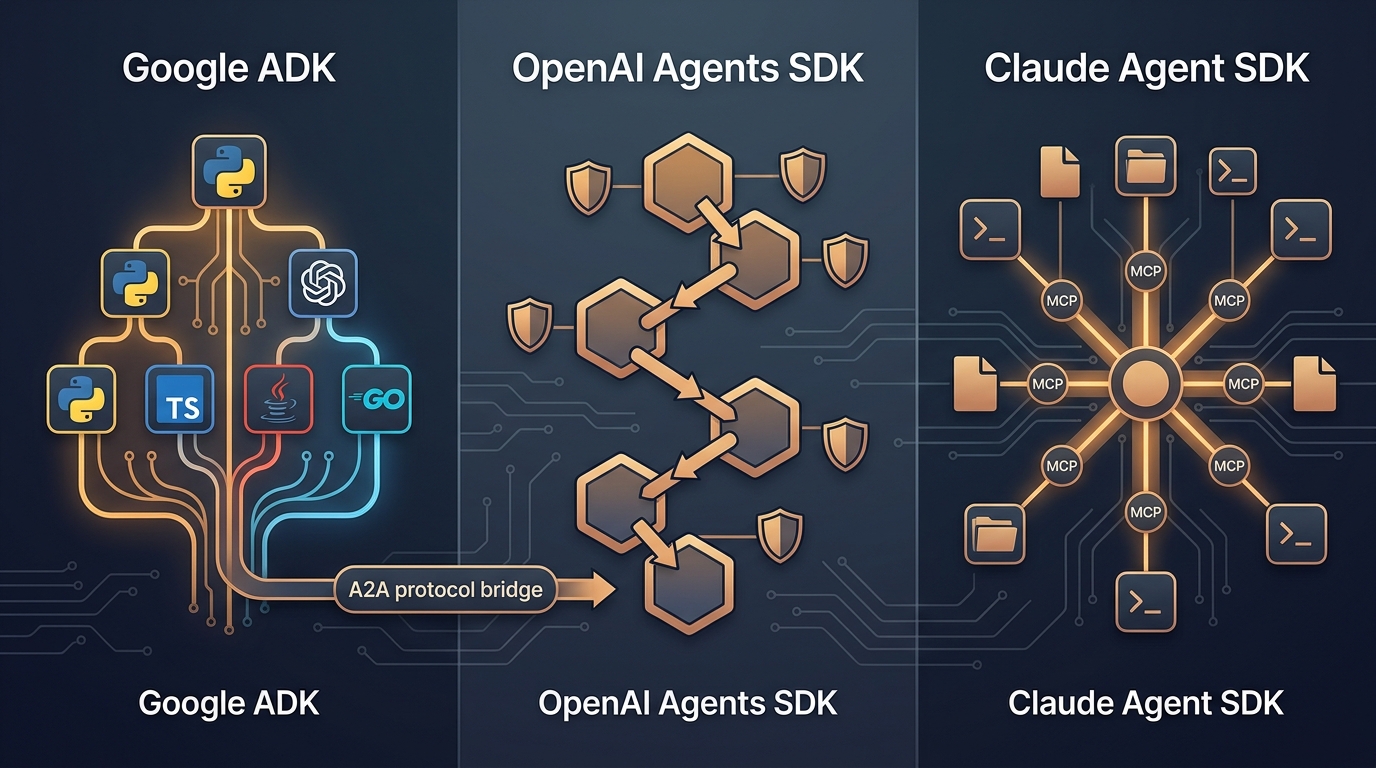
Google ADK vs OpenAI vs Claude Agent SDK: The 2026 Three-Way Comparison
Google's ADK 2.0 ships graph workflows in four languages with native A2A. OpenAI added sandbox execution and three-tier guardrails. Claude offers the deepest MCP integration in the ecosystem. We built the same multi-step agent across all three — here's how they compare, where each one wins, and what you'll regret picking.
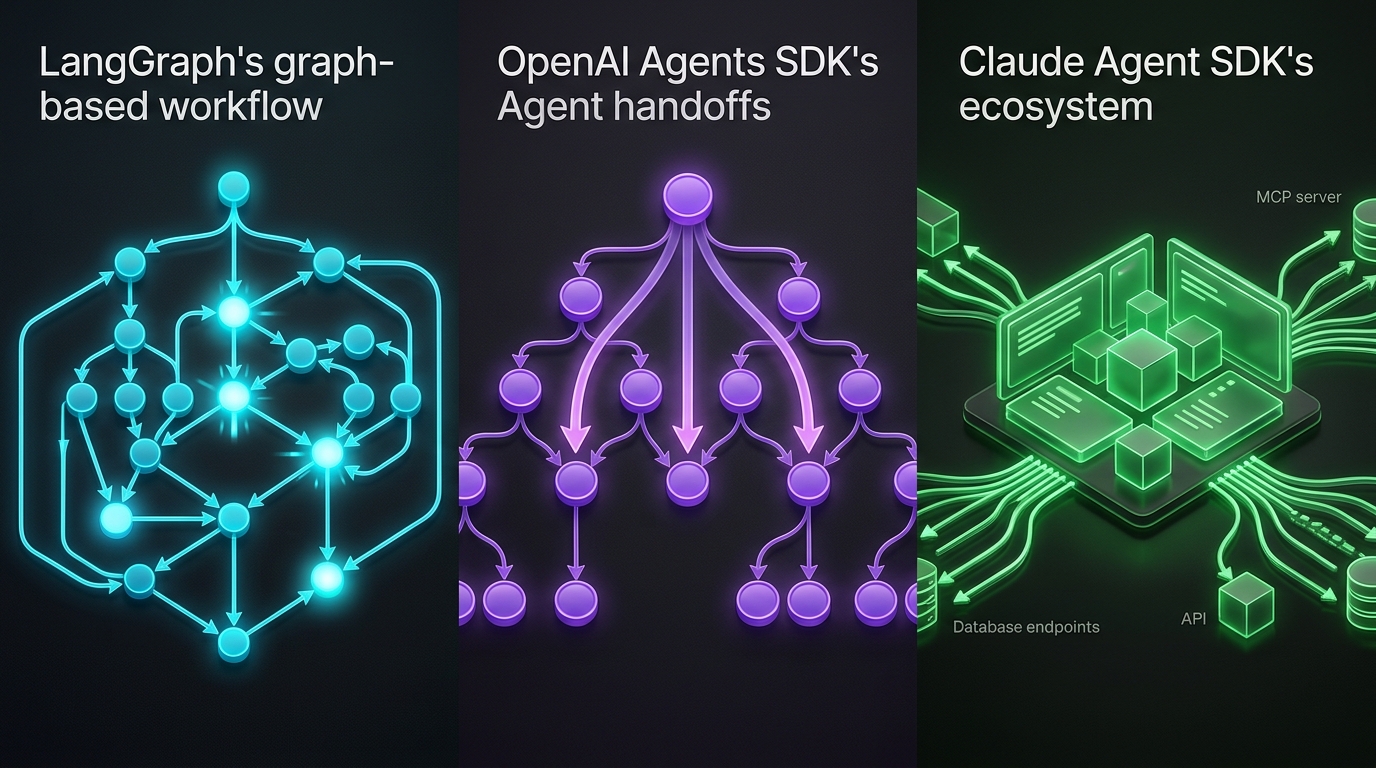
LangGraph vs OpenAI and Claude Agent SDKs Compared
LangGraph graphs, OpenAI handoffs, and Claude's MCP-native SDK — compared with code and a decision framework for 2026.

OpenAI Assistants API vs Claude MCP: Two Approaches to Building AI Agents
A comprehensive comparison of OpenAI's Assistants API and Anthropic's Model Context Protocol (MCP) for building AI agents, covering architecture, integration patterns, and when to use each approach