LangGraph vs CrewAI vs AutoGen: 2026 Comparison
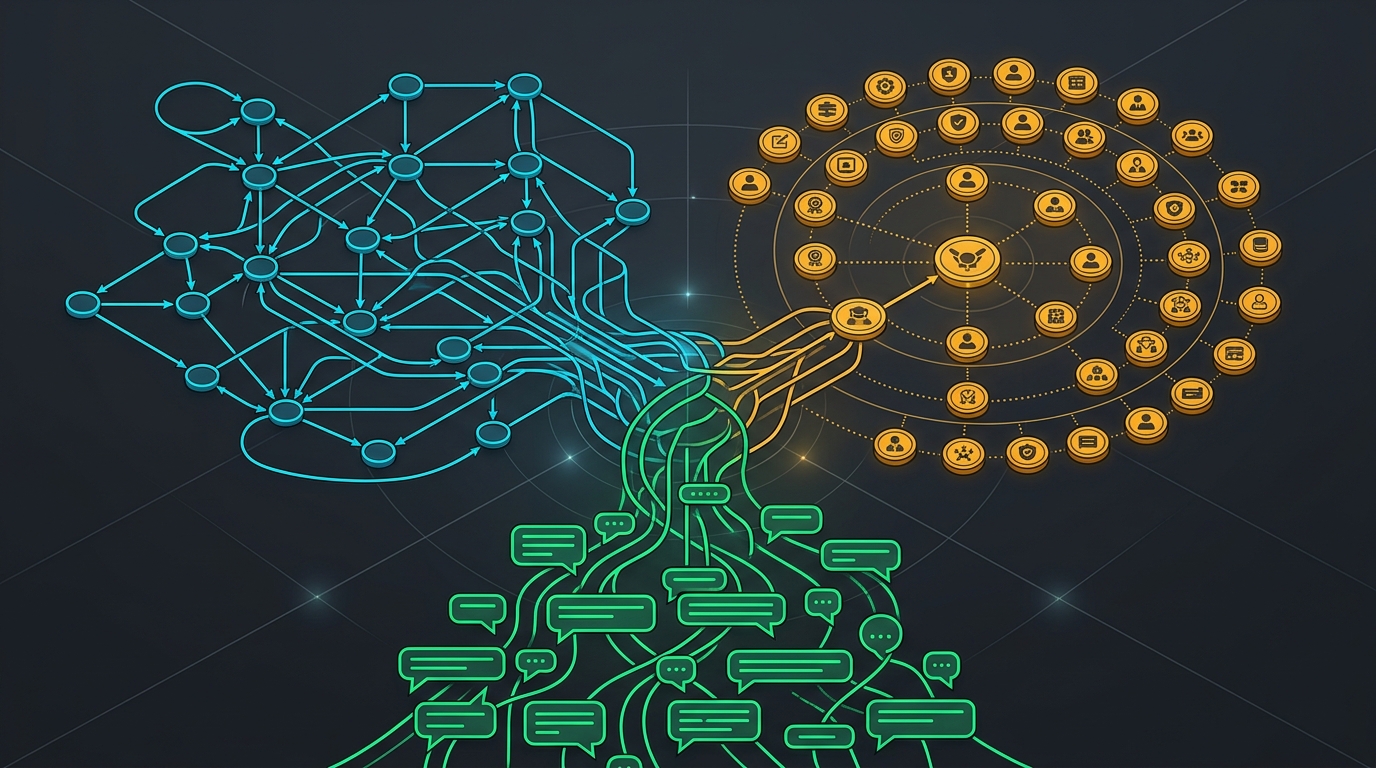
Graph orchestration vs role-based teams vs Microsoft's new Agent Framework 1.0. Architecture, production readiness, and a clear verdict.
Three frameworks dominate the open-source multi-agent conversation in 2026: LangGraph, CrewAI, and AutoGen (now evolved into the Microsoft Agent Framework 1.0 GA). Each represents a different philosophy about how agents should collaborate — and picking the wrong one will cost you weeks of refactoring.
We’ve built production systems across all three at Turion. This post cuts through the marketing and compares them on architecture, developer experience, production readiness, and the use cases where each one wins.
Skip to the bottom for our verdict and decision framework if you just need an answer.
What Each Framework Actually Does
The easiest mistake is treating these as interchangeable. They’re not. They solve fundamentally different coordination problems.
| Framework | Coordination Model | Best Mental Model |
|---|---|---|
| LangGraph | Explicit directed graphs with cyclical state | ”I build the flowchart, the framework executes it” |
| CrewAI | Role-based team with tasks and process flows | ”I hire a team, assign tasks, they figure out the rest” |
| Microsoft Agent Framework (ex-AutoGen) | Conversational multi-agent with emergent patterns | ”I put agents in a room, let them talk until the problem is solved” |
Microsoft announced Agent Framework 1.0 GA on April 3, 2026, unifying AutoGen and Semantic Kernel into a single production SDK with stable APIs across .NET and Python. The autogen_agentchat package from AutoGen v0.2 is now officially legacy — the migration path is documented in the Azure Agent Framework migration guide. This is a significant shift that most comparison posts miss.
Architecture Deep Dive
LangGraph: You Draw the Graph, It Runs the Graph
LangGraph treats agent workflows as stateful directed graphs. You define nodes (agents or functions) and edges (transitions), and LangGraph executes the graph while maintaining a single shared state object. The key abstraction is StateGraph:
from langgraph.graph import StateGraph, END
from typing import TypedDict
from langchain_core.messages import HumanMessage, AIMessage

class AgentState(TypedDict):
    messages: list
    current_step: str
    verified: bool

def research_node(state: AgentState) -> AgentState:
    """Research step — fetches data."""
    return {
        "messages": [AIMessage(content="Research complete for step 1")],
        "current_step": "research_done",
    }

def verify_node(state: AgentState) -> AgentState:
    """Verification step — only runs if research passed."""
    all_good = len(state["messages"]) > 0
    return {
        "verified": all_good,
        "current_step": "verified" if all_good else "research_done",
    }

def should_retry(state: AgentState) -> str:
    """Conditional edge — loops back if verification failed."""
    if state["verified"]:
        return "summary"
    return "research"

graph = StateGraph(AgentState)
graph.add_node("research", research_node)
graph.add_node("verify", verify_node)
graph.add_node("summary", lambda s: {"current_step": "summary"})

graph.add_edge("research", "verify")
graph.add_conditional_edges("verify", should_retry)
graph.add_edge("summary", END)

app = graph.compile()
The graph structure is your single source of truth. Every transition is explicit, every loop has a condition, and the state object is serialized at each step (enabling checkpointing and human-in-the-loop interrupts). This is why teams building agents that need audit trails, retries, or operator approval gravitate here.
Strengths:
- Deterministic control flow: You can trace exactly why a graph took a path. No black-box orchestration.
- Built-in checkpointing: LangGraph’s
checkpointerbackends (SQLite, Postgres, in-memory) persist state between turns, enabling human-in-the-loop workflows natively. See our LangGraph human-in-the-loop interrupt tutorial for patterns. - Part of the LangChain ecosystem: Access to LangSmith observability, LangChain tool abstractions, and the largest integration library in the ecosystem.
- Cycles are first-class: Retry loops, escalation paths, and multi-step verification are trivial.
Weaknesses:
- Verbosity: You write the graph. Simple two-agent handoffs need 30+ lines.
- Learning curve: Understanding
StateGraph,Send,Command, and edge conditions takes time. - Multi-agent overhead: Running N independent agents requires explicit fan-out patterns (
Send) — it’s powerful but not automatic.
For a deeper look at where LangGraph fits in the broader landscape, see our complete guide to AI agent frameworks.
CrewAI: Role-Based Teams That Delegate
CrewAI models agent collaboration after organizational hierarchy. You define agents with roles and goals, assign them tasks, and the Crew orchestrator decides the execution order. The agent doesn’t know about the graph — it just knows its job.
from crewai import Agent, Task, Crew, Process

researcher = Agent(
    role="Senior Research Analyst",
    goal="Gather comprehensive market data on the topic",
    backstory="You have 10 years of experience in market research and data analysis.",
    verbose=True,
)

writer = Agent(
    role="Content Strategist",
    goal="Write a compelling analysis based on the research",
    backstory="You are an expert at turning raw data into actionable insights.",
    verbose=True,
)

research_task = Task(
    description="Research the latest trends in AI agent orchestration frameworks.",
    expected_output="A structured report with citations.",
    agent=researcher,
)

writing_task = Task(
    description="Write a summary analysis based on the research report.",
    expected_output="A 500-word executive summary.",
    agent=writer,
)

crew = Crew(
    agents=[researcher, writer],
    tasks=[research_task, writing_task],
    process=Process.sequential,
    planning=True,
)

result = crew.kickoff()
print(result)
CrewAI’s April 2026 updates added SQLite-backed checkpointing, automatic persistence via the @persist decorator, and enterprise-grade observability integrations (CrewAI changelog). The planning=True flag adds a meta-planning agent that generates step-by-step plans before execution — a significant capability for complex workflows.
Strengths:
- Zero ceremony: You can have a working two-agent crew in under 15 lines of code.
- Intuitive mental model: If you can describe a team, you can build a crew. The role/goal/backstory structure is self-documenting.
- Planning agent: The built-in planning mode generates execution plans before tasks run, reducing hallucination on complex workflows.
- Process flexibility:
sequential,hierarchical, andconsensusmodes cover most team patterns.
Weaknesses:
- Black-box orchestration: You don’t control the execution graph. When the planning agent makes a bad split, you can’t easily override it.
- Debugging friction: Agent-to-agent handoffs are opaque. Figuring out why agent B hallucinated based on agent A’s output means reading through verbose logs.
- Limited state control: No built-in checkpointing granularity — you get full crew persistence or nothing.
Microsoft Agent Framework 1.0 (ex-AutoGen): Conversational Autonomy
AutoGen started as a Microsoft Research project exploring emergent behavior in multi-agent conversations. The Agent Framework 1.0 GA unified this with Semantic Kernel, bringing .NET parity and production stability. The core pattern remains: agents communicate via messages, and complex behaviors emerge from conversation patterns.
from autogen_agentchat.agents import AssistantAgent
from autogen_agentchat.teams import RoundRobinGroupChat
from autogen_agentchat.conditions import MaxMessageTermination
from autogen_ext.models.openai import OpenAIChatCompletionClient

model = OpenAIChatCompletionClient(model="gpt-4o")

planner = AssistantAgent(
    name="planner",
    model_client=model,
    system_message="You break down problems into steps and create plans.",
)

coder = AssistantAgent(
    name="coder",
    model_client=model,
    system_message="You write code based on the provided plan.",
)

reviewer = AssistantAgent(
    name="reviewer",
    model_client=model,
    system_message="You review code for correctness, security, and best practices.",
)

chat = RoundRobinGroupChat(
    agents=[planner, coder, reviewer],
    termination_condition=MaxMessageTermination(max_turns=10),
)

async for message in chat.run_stream(
    task="Build a REST API for managing user preferences."
):
    if hasattr(message, "content"):
        print(f"[{message.source}]: {message.content}")
Microsoft Agent Framework 1.0 introduces several capabilities that distinguish it from the legacy AutoGen: GraphFlow for explicit workflow control (parallel to LangGraph’s approach), AgentSession for persistent conversation state, MCP server support for standardized tool integration, and hosted tools for Azure-native execution. The Responses API support means you can use the OpenAI Responses API format for agents — a bridge between the conversational and imperative paradigms.
Strengths:
- Emergent problem-solving: Agents in conversation can discover solutions you didn’t pre-program. This is powerful for creative or exploratory tasks.
- MCP and A2A native: Microsoft Agent Framework supports the Model Context Protocol and Agent-to-Agent protocol out of the box — critical for interoperable agent ecosystems. See our MCP complete guide for context.
- Dual-language support: .NET and Python parity is unique in the agent framework space. If your backend is C#, this is your choice.
- MagenticOneGroupChat: Sophisticated group chat patterns with automated task decomposition and result synthesis.
Weaknesses:
- API churn during transition: Teams moving from AutoGen v0.2 need to migrate to the new Agent Framework SDK. The migration guide covers this, but it’s a non-trivial effort for production systems.
- Cost amplification: Conversational patterns mean more LLM calls. A three-agent round-robin chat generates 3x the tokens versus a sequential handoff. Without careful termination conditions, conversations can run long.
- Less predictable: Emergent behavior is great until it isn’t. In production, you want determinism more than creativity.
Head-to-Head Comparison
Developer Experience
| Dimension | LangGraph | CrewAI | Agent Framework 1.0 |
|---|---|---|---|
| Setup complexity | High (graph definition) | Low (declarative) | Medium (agent + team config) |
| Lines of code (2-agent handoff) | ~30 | ~15 | ~25 |
| Debugging | Tracing via LangSmith | Verbose logs only | Conversation replay |
| Learning curve | Steep (graph theory) | Gentle (role-based) | Medium (conversation patterns) |
| IDE support | VS Code (LangGraph Studio) | Basic | .NET/Python standard |
Winner: CrewAI for speed-to-first-agent. LangGraph for long-term maintainability.
Production Readiness
| Dimension | LangGraph | CrewAI | Agent Framework 1.0 |
|---|---|---|---|
| Checkpointing | SQLite, Postgres, Redis | SQLite via @persist | AgentSession |
| Observability | LangSmith (best-in-class) | Limited (growing) | Azure Monitor integration |
| Human-in-the-loop | Native (interrupt() pattern) | Via task delegation | Request-response API |
| Streaming | Full support | Streaming responses | Full support |
| Horizontal scale | Via serverless deployment | Single-process focus | .NET native scaling |
Winner: LangGraph, by a clear margin. Its checkpointing, LangSmith integration, and human-in-the-loop patterns are purpose-built for production deployments. CrewAI’s observability is improving but still behind.
Multi-Agent Orchestration Power
| Dimension | LangGraph | CrewAI | Agent Framework 1.0 |
|---|---|---|---|
| Parallel execution | Via Send (explicit) | hierarchical process | MagenticOneGroupChat |
| Dynamic routing | Conditional edges (deterministic) | Planning agent (black-box) | Conversation-driven (emergent) |
| State sharing | Typed state dict | Task output objects | Message history |
| Nested groups | Sub-graphs | Crew nesting | RoundRobinGroupChat nesting |
Winner: Tie between use cases. Agent Framework 1.0 for exploratory/creative tasks. LangGraph for pipelines needing deterministic routing. CrewAI for structured teams with predictable workflows.
Ecosystem & Integrations
| Dimension | LangGraph | CrewAI | Agent Framework 1.0 |
|---|---|---|---|
| LLM providers | 20+ (LangChain) | OpenAI, Anthropic, Google, Azure | OpenAI, Azure, local adapters |
| Tool integrations | LangChain hub (500+) | CrewAI tools (growing) | MCP servers, hosted Azure tools |
| Community | Largest (LangChain) | Active, fast-growing | Enterprise-focused |
| Documentation | Excellent | Good, improving | Microsoft standard |
Winner: LangGraph. The LangChain ecosystem simply has the broadest provider support, most tools, and largest community.
When to Use Each Framework
Use LangGraph When
You need deterministic, auditable agent workflows with explicit control over every step. This includes:
- Financial compliance workflows where every decision must be traced
- Agents with human-in-the-loop approval gates
- Multi-step processes with conditional branching and retries
- Systems where you’re already invested in the LangChain ecosystem
We use LangGraph for any agent where the cost of a wrong decision is high. The graph structure gives you an executable specification — if the graph looks correct, the agent will behave predictably.
Use CrewAI When
You want rapid prototyping of multi-agent teams with clear role separation. This includes:
- Content generation pipelines (research + write + edit)
- Analysis workflows with specialized agents per domain
- Teams where the execution order matters less than agent specialization
- Projects where non-engineers need to understand the agent architecture
CrewAI is our recommendation when the coordination pattern is simple and the complexity lives in individual agent roles.
Use Microsoft Agent Framework When
You need conversational multi-agent systems that can discover solutions autonomously, or you’re in the Azure/.NET ecosystem:
- Research and exploration tasks where rigid workflows are limiting
- Agent systems that benefit from emergent problem-solving patterns
- .NET/C# codebases needing first-class agent framework support
- Systems requiring MCP or A2A protocol interoperability
Agent Framework 1.0’s GraphFlow pattern also makes it increasingly competitive with LangGraph for deterministic workflows — but LangGraph still has a head start in production tooling.
Our Verdict
Here’s our honest take at Turion, based on shipping agents across all three:
For production systems in 2026, LangGraph is the default choice. Its explicit graph model, best-in-class observability via LangSmith, and mature checkpointing make it the safest bet for teams that need reliability over novelty. The learning curve is real, but it pays off the moment you need to debug why an agent made a particular decision or add a human approval step.
CrewAI wins for speed and simplicity. If your multi-agent pattern is essentially “agent A does work, passes to agent B,” CrewAI gets you there in half the code. Just know that you’re trading control for convenience — and that trade compounds as system complexity grows.
Microsoft Agent Framework 1.0 is the dark horse. The April 2026 GA release with unified .NET/Python support, MCP native integration, and the convergence of AutoGen + Semantic Kernel makes it genuinely production-ready. It’s our pick for Azure-native teams and systems requiring protocol interoperability. The main risk is ongoing API stability during the AutoGen migration period.
The landscape is converging: LangGraph is adding more multi-agent primitives, CrewAI is building better observability, and Microsoft Agent Framework is absorbing the best ideas from both AutoGen and Semantic Kernel. But today, the control-vs-convenience-vs-conversation framework remains the cleanest way to choose:
- Control → LangGraph
- Convenience → CrewAI
- Conversation → Microsoft Agent Framework
For a broader view of where agent frameworks fit in a complete AI stack, see our AI infrastructure stack guide, and for deeper coverage of agent protocol standards, read our protocol stack deep dive.
Related Posts

AutoGen vs CrewAI: Choosing the Right Framework
AutoGen vs CrewAI: head-to-head on architecture, ease of use, and use cases for multi-agent systems. Pick the right framework.
Complete Guide to AI Agent Frameworks 2026
OpenAI Agents SDK, Claude Agent SDK, LangGraph, CrewAI compared — with benchmarks and a decision framework for your AI stack.

The Complete Guide to AI Agent Frameworks in 2024
A comprehensive 3000+ word guide covering all major AI agent frameworks, their architectures, strengths, use cases, and how to choose the right one for your project