Cursor vs Claude Code: Which AI Coding Agent Wins in 2026?
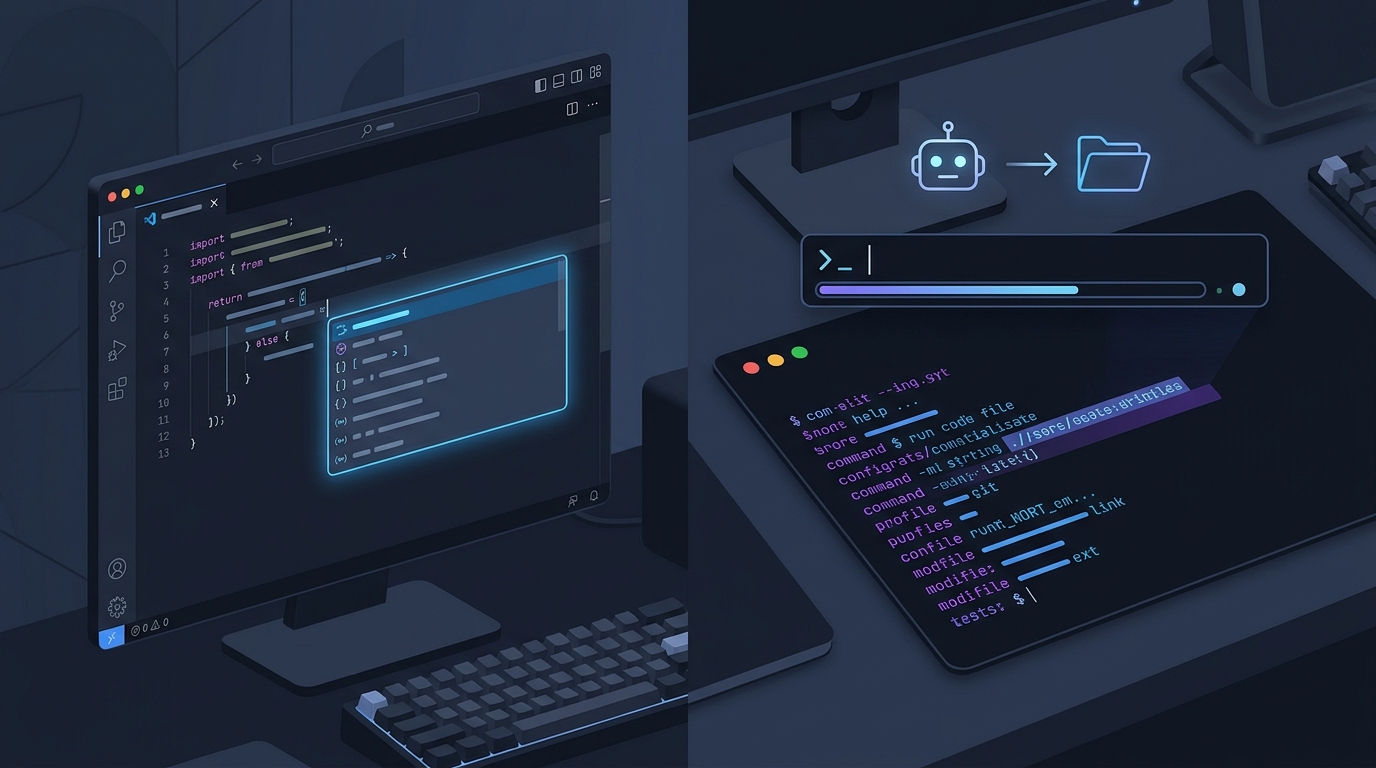
IDE-native AI vs autonomous terminal agent. Head-to-head on autocomplete, multi-file ops, pricing, and SWE-bench scores. Clear verdict included.
Cursor vs Claude Code: Which AI Coding Agent Wins in 2026?
Two tools dominate the AI coding conversation right now. Cursor—the AI-native IDE fork of VS Code—and Claude Code—Anthropic’s autonomous terminal agent. Both have matured significantly in the past twelve months. Both cost $20/month to start. But they solve fundamentally different problems, and picking the wrong one for your workflow is expensive in time and money.
We’ve run both in production across different project types. Here’s the honest breakdown.
The Core Distinction: Augmented vs. Delegated Engineering

Before diving into features, you need to understand what each tool is actually doing.
Cursor augments how you write code. It sits inside your editor, sees what you’re typing, and makes you faster. It’s IDE-first: the AI is embedded in the writing experience.
Claude Code delegates coding tasks to an agent. You describe a goal in the terminal, and an autonomous agent reads your files, installs dependencies, writes code across multiple files, runs tests, and commits changes. You’re directing, not writing.
The distinction sounds academic until you hit a concrete use case:
- “Add an
isActivefield to this User model” → Cursor is faster. Inline edit, done in 30 seconds. - “Add OAuth2 authentication to this Express app” → Claude Code wins. It reads your existing middleware, installs
passport, creates auth routes, adds session handling, updates your schema, and verifies the dev server starts—without you touching a file.
Keep this in mind throughout. They’re not competing for the same job.
Cursor: What It Does Well
Tab Autocomplete That Actually Reads Intent
Cursor’s Tab completion is the best inline code completion available in 2026. It doesn’t complete tokens—it completes logic. If you’ve written three similar handler functions, it understands the pattern and offers the fourth one wholesale. Accepting is one keypress.
This is Cursor’s defensible advantage. No terminal-based tool comes close to this latency (200–500ms) and context awareness for moment-to-moment coding.
The IDE Experience Is Zero-Friction
Cursor is VS Code. Your extensions, keybindings, themes, and .vscode configs work. If your team is already on VS Code, onboarding is installing one app. There’s no context switching—AI is just another panel.
Multi-Model Flexibility
Cursor supports OpenAI, Anthropic, Google Gemini, and xAI models. You’re not locked to one provider. In Agent mode, you can run Claude Sonnet 4.6 for complex reasoning or switch to a cheaper model for routine edits. The April 2026 Cursor 3 interface overhaul also added parallel agent panes—you can run multiple Cursor agents across repos simultaneously in a tiled layout.
BugBot: Automated Code Review
BugBot now achieves a 78% resolution rate on pull requests, learns from feedback over time, and supports MCP servers for additional context during reviews. For teams already in Cursor, this is substantial value—automated review integrated directly into your PR workflow.
Claude Code: What It Does Well
Autonomous Multi-File Operations
Claude Code’s strength is its agentic depth. Give it a goal, walk away, come back to a working implementation. A prompt like “Add rate limiting to all API endpoints” results in the agent reading every route file, installing the appropriate library, writing middleware, adding configuration, and running your test suite to verify nothing broke.
Independent benchmarks put Claude Code at 72.5% on SWE-bench Verified as of March 2026—meaningfully ahead of Cursor’s Background Agent mode (~65.7% on the same benchmark). The gap isn’t purely model quality; it’s scaffolding. Claude Code’s agentic framework—how it retrieves context, manages tool calls, and handles state—adds ~6–7 percentage points on top of the underlying model.
Token Efficiency
One often-cited finding: Claude Code uses 5.5× fewer tokens than Cursor for equivalent autonomous tasks. Cursor’s RAG-based codebase indexing consumes significant context for retrieval, while Claude Code reads files directly from the filesystem. For large refactoring jobs, this translates to both lower API costs and better coherence.
Subagents and Parallel Execution
Claude Code’s subagent system is a genuine force multiplier. You define specialist agents as Markdown files in .claude/agents/—each with its own system prompt, tool access, and model selection. An orchestrator dispatches work across a security-review agent, a test-writing agent, and an implementation agent simultaneously.
# .claude/agents/security-reviewer.md
---
name: security-reviewer
model: claude-opus-4-6
tools: [read_file, search_files]
---
You are a security code reviewer. Focus exclusively on authentication,
authorization, input validation, and injection vulnerabilities. Read-only access only.
Agent Teams extends this further: multiple Claude instances share a task list, pick up work concurrently, and update progress in real time. For decomposable large-scale work—migrating a codebase to a new framework, auditing 200 files for compliance—this is a qualitative step change.
MCP Integration
Claude Code’s MCP support lets agents reach external services—databases, APIs, monitoring tools—within the same agentic workflow. Subagents inherit MCP tools from the parent context, or you can restrict them explicitly. An orchestrator can spin up a subagent with Postgres access to run migrations while another subagent rewrites the ORM layer in parallel.
Head-to-Head: Feature Comparison
| Dimension | Cursor | Claude Code |
|---|---|---|
| Inline autocomplete | ✅ Best-in-class (200–500ms) | ❌ Terminal-only |
| IDE integration | ✅ Full VS Code experience | ⚠️ Editor-agnostic (use alongside any IDE) |
| Multi-file autonomous ops | ⚠️ Capable, shallower context | ✅ Superior depth |
| Model flexibility | ✅ OpenAI, Claude, Gemini, xAI | ❌ Claude models only |
| Subagent / parallel agents | ⚠️ Parallel Cursor agents (Apr 2026) | ✅ Native Task tool + Agent Teams |
| MCP support | ✅ Added Apr 2026 | ✅ Mature integration |
| SWE-bench (Verified) | ~65.7% (Background Agent) | 72.5% |
| Codebase indexing | RAG-based (accuracy drops cross-file) | Direct filesystem reads |
| Large monorepo support | ⚠️ Struggles above 50K files | ✅ Scales better |
| GitLab support | ❌ Not supported | ✅ Full git support |
| Code review (PR) | ✅ BugBot (78% resolution) | ❌ Not a built-in feature |
Pricing: Honest Math
Both tools start at $20/month, which makes the entry price equivalent. The divergence is in the ceiling.
Cursor pricing:
- Hobby: Free, limited requests
- Pro: $20/month — frontier model access, MCPs, Cloud Agents
- Pro+: $60/month — 3× usage on OpenAI/Claude/Gemini
- Ultra: $200/month — 20× usage, priority access
- Teams: $40/user/month — shared configs, SSO, analytics
Claude Code pricing (via Anthropic subscriptions):
- Pro: $20/month — Claude Code included, entry limits
- Max 5×: $100/month — 5× Pro capacity per session
- Max 20×: $200/month — 20× Pro capacity
- Team Premium: $100/seat/month (5-seat minimum) — required for team Claude Code access
⚠️ Pricing gotcha: Anthropic briefly appeared to move Claude Code behind Max-only in April 2026 before reversing course. Claude Code is currently available on Pro ($20/month), but heavy daily use—multi-file agentic sessions, parallel subagents—will consume Pro limits quickly and push you toward Max 5× ($100/month).
Real-world cost comparison for a full-time developer:
| Usage pattern | Cursor | Claude Code |
|---|---|---|
| Occasional autocomplete + chat | Pro ($20/mo) | Pro ($20/mo) |
| Daily coding + some agent tasks | Pro+ ($60/mo) | Pro ($20/mo) or Max 5× ($100/mo) |
| Heavy multi-file agents daily | Ultra ($200/mo) | Max 5× ($100/mo) |
| High-volume refactoring/automation | Ultra ($200/mo) | Max 20× ($200/mo) or API |
One caveat: Cursor’s credit system can be opaque under heavy load. Reports exist of teams burning through credits unexpectedly—one $7,000 annual subscription depleted in a day under surge usage. Claude Code’s Max plan is a clearer flat-rate ceiling for agentic work.
The Context Window Problem (Cursor’s Real Limitation)
This is Cursor’s most significant under-discussed weakness.
Cursor doesn’t expose the full model context window to your code. After accounting for system prompts, codebase indexing chunks, conversation history, and automatically included file contents, effective usable context is consistently less than half the advertised window.
A 10,000-line TypeScript project runs roughly 200K tokens. Cursor’s RAG-based indexing retrieves relevant chunks via embeddings—but retrieval accuracy degrades for cross-file type relationships and indirect dependencies. Users consistently report that Composer/Agent mode is “shallow” when you don’t explicitly specify which files to include.
Above ~50,000 files, monorepo performance degrades: planning hangs, rate limit errors, and incomplete dependency graphs appear regularly on the community forum.
Claude Code sidesteps this entirely by reading directly from the filesystem. There’s no retrieval layer—the agent looks at exactly the files it needs, when it needs them, using tools rather than pre-ingested embeddings.
When to Choose Cursor
Use Cursor as your primary coding environment if:
- You’re an individual developer who writes code actively all day and wants AI-accelerated typing
- Your team is already on VS Code and switching cost matters
- You work on well-scoped features where inline completion and quick multi-turn chat is the majority of AI interaction
- You need PR code review integrated into your workflow (BugBot)
- You want model flexibility—running different providers for different tasks
Don’t lean on Cursor’s agent mode for complex, cross-cutting architectural changes. It works, but you’ll spend more time shepherding context than a terminal agent requires.
When to Choose Claude Code
Use Claude Code as your execution engine if:
- You’re tackling large autonomous tasks: migrations, refactors across hundreds of files, scaffolding new services
- You need multi-agent parallelism—running independent agents on separate concerns simultaneously
- Token efficiency matters—you’re billing by consumption and don’t want retrieval overhead eating your context
- You work in large monorepos where Cursor’s indexing breaks down
- You’re building agent-to-agent workflows using MCP and the Task tool
- You use GitLab (Cursor doesn’t support it)
Claude Code’s learning curve is steeper. You need to think in terms of goals and agent permissions rather than file selections and inline prompts. But for complex work, that abstraction pays off.
Our Recommendation: Run Both
The developers shipping fastest in 2026 are not picking one. The most common setup on r/cursor and r/ClaudeCode is both tools at entry tier, ~$40/month combined, with a clear division of responsibility:
- Cursor as the editor for active writing—autocomplete, quick refactors, PR review
- Claude Code in a terminal pane for heavy lifting—agentic tasks, migrations, test generation, architectural changes
This isn’t hedging. It’s the right architecture for the tools’ actual strengths. Cursor makes you faster when you’re writing. Claude Code makes you faster when you’re not writing—when you’d otherwise spend hours on work the machine can do autonomously.
If you have to pick one: Cursor for daily writing velocity, Claude Code for autonomous execution at scale. If your work is mostly feature development with occasional big refactors, start with Cursor Pro at $20/month. If your work is mostly large-scale codebase operations with occasional writing, start with Claude Code Pro.
For deeper context on what Claude Code’s autonomous agent mode can do, see our Claude Code deep dive and the subagents orchestration guide.
Pricing and features verified against cursor.com/pricing, claude.com/pricing, and Anthropic’s Claude Code docs as of April 2026.
Related Posts

LiteLLM vs Portkey vs Kong: LLM Gateway Pricing — June 2026
LiteLLM is free but costs $500–$2,000/mo to self-host. Portkey starts at $49/mo (log-based). Kong at $25/mo per control plane. The real cost of each — with hidden ops and scaling traps.

Enterprise Agent Platforms: Salesforce vs ServiceNow vs Microsoft — June 2026
Salesforce Agentforce at $2/conversation. ServiceNow AI Agents bundled into ITSM tiers at $100–150/user/mo. Microsoft Copilot Studio at $200/tenant/mo for 25K credits. Which enterprise platform actually ships?
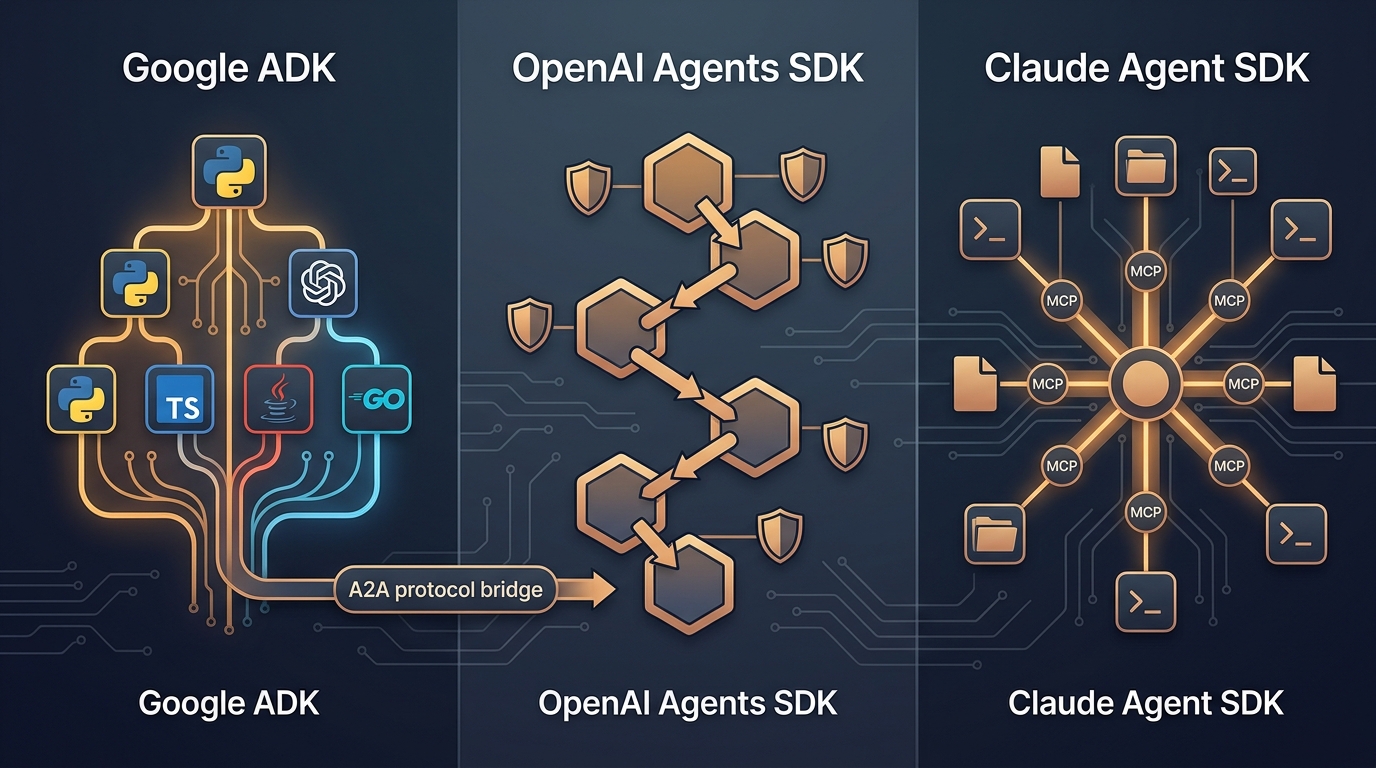
Google ADK vs OpenAI vs Claude Agent SDK: The 2026 Three-Way Comparison
Google ADK vs OpenAI vs Claude Agent SDK: we built the same agent across all three. Here's how they compare, where each wins, and what to avoid.